Two Little Dicky Birds
|
Two Little Dicky Birds
Author: Yeap Ban Har
ISBN:
LCCN:
Dewey:
Number:
|
Category: User
Rating: Pages: 0
Paperback Marshall Cavendish/Singapore Math
Twizzlers Percentages Book
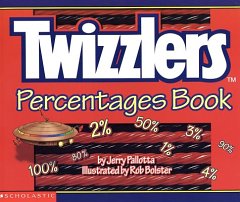 |
Twizzlers Percentages Book
Author: Pallotta, Jerry
Bolster, Rob (Illustrator) Bolster, Rob
ISBN:
0-439-15430-8
LCCN: 00068755
Dewey: 513.2/4
21
Number:
|
Category:
Fiction
User Rating: 4.5 Stars
Pages: 32
Paperback Cartwheel
From School Library Journal Grades 2-4--This colorful book uses Twizzlers as
the device to clarify the concepts and will definitely get students' attention.
The page that illustrates 100% has 90 red Twizzlers and 10 black ones arranged
across the spread. However, readers who are not familiar with math may be
confused as the terms "numerator" and "denominator" are introduced on page 2 but
not defined until page 10 and on occasion a term is used in its own definition.
In addition, the use of a talking spaceship seems unnecessarily juvenile and
does not relate clearly to the candy theme. This disjointed approach is also
apparent in the sudden introduction of baseball statistics as percentages; they
are an abrupt curveball in the normal flow of the text and examples. Also, the
mention of "rounding off" and the term "non-terminating decimals" on the next to
last page create unnecessary confusion. A book with potential if used
judiciously. Edith Ching, St. Albans School, Mt. St. Alban, Washington, DC
Copyright 2002 Cahners Business Information, Inc. Book Description What better
way to introduce the concept of percentages than with delicious Twizzlers candy?
As he¹s done with fractions, addition, and counting, author and educator Jerry
Pallotta teaches percentages in the fun and relaxed way that has become his
trademark.
Treasure Map
 |
Treasure Map
Author: Murphy, Stuart J. Tusa, Tricia
(Illustrator) Tusa, Tricia
ISBN: 0-06-446738-4
LCCN:
2003017674
Dewey: 912/.01/4 22
Number:
|
Category: Juvenile
Mathematics
User Rating: 4.0 Stars
Pages: 40
Paperback HarperTrophy
From Booklist Gr. 2-3, younger for reading aloud. This entry in the MathStart
series takes on beginning map-reading skills. When one of the members of the Elm
Street Kids Clubfinds a treasure map, all the kids join in the fun to search for
the treasure. Several math-related concepts, such as problem solving and
estimation, are modeled as the kids look at the 50-year-old map and, following
directions such as "turn left," try to make it fit a present-day landscape. The
mapping concepts are not presented as effectively as they could have been (the
map shows a compass rose and a legend, though these terms are never mentioned in
the text), but there's a lot here for adults to build on. Tusa's
watercolor-and-ink cartoon-style illustrations, while nicely done, divert from
the main story line with an unexplained fantasy sideshow that may confuse some
children. Companion activities and a short bibliography are included. Lauren
Peterson Copyright © American Library Association. All rights reserved --This
text refers to the Hardcover edition. Product Description Matthew has found a
treasure map, and soon the Elm Street Kids' Club is off on a quest. The map
guides them into a wonderful, magical world, but it's the real-life math skills
of understanding distance, scale, direction, and symbols that will help Matthew,
Sheri, Meg, Danny, and Jed -- with some assistance from Petey the parrot -- find
a treasure hidden fifty years ago.
The Tortoise and the Hare
|
The Tortoise and the Hare
Author: Yeap Ban Har
ISBN:
LCCN:
Dewey:
Number:
|
Category: User
Rating: Pages: 0
Paperback Marshall Cavendish/Singapore Math
Too Many Kangaroo Things to Do!
 |
Too Many Kangaroo Things to Do!
Author: Murphy,
Stuart J. O'malley, Kevin (Illustrator)
ISBN:
0-06-446712-0
LCCN:
Dewey:
Number:
|
Category: Juvenile
Mathematics
User Rating: 5.0 Stars
Pages: 40
Paperback HarperTrophy
From School Library Journal PreSchool-Grade 2-Each of these books focuses on
a simple math concept: matching, time lines, or multiplication. In the first
title, the rhymed narrative tells of a sock's search through the house for its
mate. When the two are reunited and a torn heel mended, the pair is whole and
wearable. A double-page spread allows children to match pairs of socks. In Get
Up and Go, the amount of time spent by a girl in various tasks is visually
represented; here, the explanation is not as clearly expressed. Told in rhyme by
her dog, the story is interspersed with line graphs that display the number of
minutes used for each activity. In Kangaroo, the main character hunts for a
playmate and finds that everyone is busy. All of their activities are listed and
then multiplied by one through four. Kangaroo soon discovers that his friends
are preparing a birthday party that culminates with all of their endeavors
adding up to 100. Bright hues of acrylic paint and collage are used in the
cartoon illustrations. All of these titles end with helpful hints about using
the books to teach additional concepts and are best used in a one-on-one
setting. Marsha McGrath, Clearwater Public Library, FL Copyright 1996 Reed
Business Information, Inc. Product Description It's Kangaroo's birthday, but no
one will play with him: not the emu, the platypuses, the koalas, or even the
dingos. They all have too many things to do. What exactly are they doing?
They're using multiplication to figure out just how many things they have to do
to plan a big surprise for Kangaroo! Best Children's Science Books 1997
(Science Books and Films)
Tally O'Malley
 |
Tally O'Malley
Author: Murphy, Stuart J. Jabar,
Cynthia (Illustrator) Jabar, Cynthia
ISBN:
0-06-053164-9
LCCN: 2003017619
Dewey: [E]
22
Number:
|
Category:
Mathematics
User Rating: 5.0 Stars
Pages: 40
Paperback HarperTrophy
Product Description The O'Malleys are off to the beach! But it's a long, hot,
boring drive. What can Eric, Bridget, and Nell do to keep busy? Play tally
games, of course -- counting up all the gray cars or green T-shirts they see.
Whoever has the most marks at the end wins the game. Eric wins the first game.
Bridget wins the second. It seems like poor Nell will never win a game! But Nell
has the luck of the Irish on her side, and a surprise in store for her big
brother and sister. About the Author Stuart J. Murphy is a visual learning
specialist. A graduate of the Rhode Island School of Design, he has a strong
background in design and art direction. He also has extensive experience in the
world of educational publishing. Drawing on all these talents, Stuart J. Murphy
brings a unique perspective to the MathStart series. In MathStart books,
pictures do more than tell stories; they teach math. Stuart J. Murphy and his
wife, Nancy, live in Boston.
Super Sand Castle Saturday
 |
Super Sand Castle Saturday
Author: Murphy, Stuart J.
Gorton, Julia (Illustrator) Gorton, Julia
ISBN:
0-06-446720-1
LCCN: 98003210
Dewey: 530.8
21
Number:
|
Category:
Fiction
User Rating: 3.0 Stars
Pages: 40
Paperback HarperTrophy
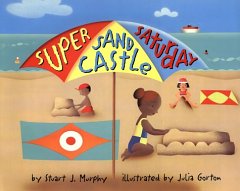
From School Library Journal Grade 1-3-Under Larry the Lifeguard's watchful
eye, three friends compete to see who can build the tallest sand castle, the
deepest moat, and the longest wall. When they start to measure the results,
trouble begins because each contestant uses a different nonstandard unit of
measurement. Sarah's tower is three shovels tall; Juan's is only two shovels
tall, but Sarah's shovel is much smaller than Juan's. And voil?-the concept of
measurement is aptly and creatively presented. Murphy does a good job of
imparting the math lesson while delivering a natural story. Gorton's stylized
airbrushed acrylics add a whimsical touch. The multiethnic cast frolics on the
beach with energy. The illustrations clearly show the comparisons while the
children are measuring and complete the picture of how a moat that's two spoons
deep could be more shallow than the moat that is one spoon deep. Pair this with
Loreen Leedy's Measuring Penny (Holt, 1998) for a complete picture of
measurement and comparison. And remember Larry's advice, "Spoons and shovels and
people's feet can all be different sizes,...but an inch is always an inch."-Jane
Claes, T. J. Lee Elementary School, Irving, TX Copyright 1999 Reed Business
Information, Inc. --This text refers to the Library Binding edition. From Kirkus
Reviews PLB 0-06-027613-4 This entry in the MathStart series explores the
hazards of measuring in nonstandard units. Eager to win prizes from Larry the
lifeguard for the tallest tower, longest wall, and deepest moat, Juan, Sarah,
and Laura compare their sand castles; they discover that Sarah's castle is three
shovels tall while Juan's is but two, Laura's moat is one spoon deep while
Juan's is two, and Laura's wall is five steps long to Sarah's seven. However, as
observant viewers will note, Sarah's spoon is longer than Juan's, her shovel and
feet shorter. Wielding a tape measure, Larry explains why inches are more
reliable units than spoons, etc. People and objects in Gorton's simple air
brushed cartoons stand out distinctly against the green ocean and sun-drenched
sand, and lines of measurement are laid out for viewers to compare. With the
small type activity notes at the end, this makes a pleasant, painless way for
children (and dare we say adults?) to pick up some basic math methodology. For
those who resist Larry's strict notions, bring out Loreen Leedy's blithe
Measuring Penny (p. 270) for a more generous examination of nonstandard
measurements. (Picture book. 6-8) -- Copyright ©1998, Kirkus Associates, LP. All
rights reserved. --This text refers to an out of print or unavailable edition of
this title.
The Sundae Scoop
 |
The Sundae Scoop
Author: Murphy, Stuart J. Jabar,
Cynthia (Illustrator) Jabar, Cynthia
ISBN:
0-06-446250-1
LCCN: 2001024322
Dewey: 511/.6
21
Number:
|
Category:
Juvenile Mathematics
User Rating: 4.0 Stars
Pages:
40
Paperback HarperTrophy
From Booklist Gr. 1-3. The latest addition to the Math Start series presents
the concept of combinations in a story about a group of children who host an
ice-cream booth at their school picnic. With two flavors of ice cream, two
sauces, and two choices of toppings, the children are surprised that eight
different sundaes are available. But when Lauren spills the sprinkles, only four
sundae possibilities remain. Then James spills the caramel sauce, and only two
sundae choices are left. Murphy easily folds the math concepts into a lively
story that will capture young readers, and Jabar reinforces the lesson with
colorful, whimsical drawings of delectable ice-cream scoops. The book closes
with follow-up activities that will be useful for parents and teachers who want
to encourage children to create similar stories using this concept. Helen
Rosenberg Copyright © American Library Association. All rights reserved --This
text refers to an out of print or unavailable edition of this title. Product
Description How many different ice-cream sundaes can you make? With 6
ingredients to choose from, there are so many combinations. Read all about the
sundaes they're making at the school picnic. Math has never been so delicious!
Subtraction at School
|
Subtraction at School
Author: Jennifer Rozines Roy
and Gregory Roy
ISBN:
LCCN:
Dewey:
Number:
|
Category:
User Rating: Pages: 0
Paperback Singapore Math/Marshall Cavendish
Spunky Monkeys on Parade
 |
Spunky Monkeys on Parade
Author: Murphy, Stuart J.
Cravath, Lynne Woodcock (Illustrator)
ISBN:
0-06-446727-9
LCCN: 98006936
Dewey: [E]
21
Number:
|
Category:
Mathematics
User Rating: 4.0 Stars
Pages: 40
Paperback HarperTrophy
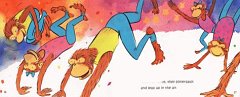
From Library Journal Kindergarten-Grade 2-This lively concept book offers a
rollicking introduction to beginning multiplication. Readers learn to count by
twos, threes, and fours as they follow a group of exuberant monkeys parading
down the street. The action begins with a scene in a dressing room filled with
monkeys getting dressed, putting on makeup, and rehearsing their acts, and ends
with the Monkey Queen and King throwing bananas to the crowd. Each bright,
colorful illustration suggests plenty of movement and excitement. The rhythmic
text adds to the parade theme, while the animals' shenanigans make counting fun.
A note to adults gives suggested activities to reinforce the ideas presented in
the book. Also included is a list of other titles that focus on the same
concepts. Anne Knickerbocker, Cedar Brook Elementary School, Houston, TX
Copyright 1999 Reed Business Information, Inc. School Library Journal "[A]
lively concept book."
Spaghetti And Meatballs For All
 |
Spaghetti And Meatballs For All
Author: Burns,
Marilyn Silveria, Gordon (Illustrator) Tilley, Debbie
ISBN:
0-590-94459-2
LCCN: 96036082
Dewey: [Fic]
20
Number:
|
Category:
Juvenile Fiction
User Rating: 5.0 Stars
Pages: 40
Hardcover Scholastic Press
From School Library Journal Grade 2-4?Mr. and Mrs. Comfort decide to have a
family dinner and invite their children, parents, in-laws, and neighbors. To
seat the 32 guests, eight square tables and the appropriate number of chairs are
rented and arranged according to a plan devised by Mrs. Comfort. However, as the
guests arrive, they rearrange the furniture so they can sit together, resulting
in mayhem until Mrs. Comfort's original configuration once again evolves.
Subtitled "A Mathematical Story," the focus of this picture book is math
concepts, not story. A note for adults suggests exercises in shapes and
perimeter. Somewhat humorous, sketchy cartoons are busy and cluttered as guests
of various ages and ethnicity rearrange furnishings, table settings, and food.
While teachers might find this title useful for conveying math ideas, it is not
a necessary purchase for most libraries.?Virginia Opocensky, formerly at Lincoln
City Libraries, NE Copyright 1997 Reed Business Information, Inc. Card catalog
description The seating for a family reunion gets complicated as people
rearrange the tables and chairs to seat additional guests.
Sorting at the Ocean
|
Sorting at the Ocean
Author: Jennifer Rozines Roy and
Gregory Roy
ISBN:
LCCN:
Dewey:
Number:
|
Category:
User Rating: Pages: 0
Paperback Singapore Math/Marshall Cavendish
Sluggers' Car Wash
 |
Sluggers' Car Wash
Author: Murphy, Stuart J.
Saltzberg, Barney (Illustrator) Saltzberg, Barney
ISBN:
0-06-446248-X
LCCN: 00054062
Dewey: 513.2/11
21
Number:
|
Category:
Juvenile Mathematics
User Rating: 4.5 Stars
Pages:
40
Paperback HarperTrophy
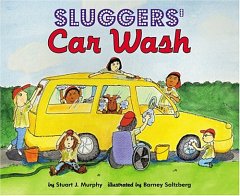
From School Library Journal Grade 2-3-A great combination of a lesson learned
while having fun. The 21st Street Sluggers decide to hold a car wash to raise
money for new T-shirts for the play-offs. CJ becomes the self-appointed
bookkeeper, collecting $3.50 from each customer and making change while the rest
of the team does the actual washing. Change is made in numerous ways and profits
are tallied both in totals and by types of coins. In the end, the money is
raised and the kids are wet. Colorful illustrations both enhance the story line
and elucidate the math lesson with clear tabulations for the money counting and
change. Follow-up activities and a reading list are included. Nancy A. Gifford,
Schenectady County Public Library, NY Copyright 2003 Reed Business Information,
Inc. --This text refers to the Hardcover edition. From Booklist Gr. 1-3. The
Sluggers baseball team has a car wash to earn the money for new T-shirts. While
most of his teammates scrub, rinse, and polish the cars, CJ serves as the
accountant, sips lemonade, and makes change for the customers. At the end of the
day, the workers turn the hose on the one member of the carwash team who never
got his hands wet. The closing pages, "For Adults and Kids," offer suggestions
of activities that support the math concepts, ways to help children feel more
comfortable figuring dollars and cents, and a couple of picture books to
reinforce the ideas. As CJ keeps track of money in the story, readers can follow
along by watching the sums on his clipboard. Some may even learn to make change,
a simple activity that seems to confuse even cashiers these days. Saltzberg's
colorful illustrations reflect the jovial tone of the text in this appealing
addition to the Math Start series. Carolyn Phelan Copyright © American Library
Association. All rights reserved --This text refers to the Hardcover edition.
Skittles Riddles Math
 |
Skittles Riddles Math
Author: McGrath, Barbara
Barbieri Glass, Roger (Illustrator) Glass, Roger
ISBN:
1-57091-413-3
LCCN: 00038372
Dewey: 372.7/044
21
Number:
|
Category:
Mathematics - Arithmetic
User Rating: 5.0 Stars
Pages:
32
Paperback Charlesbridge Publishing
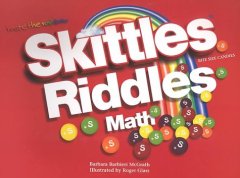
From School Library Journal Gr 1-3-The book introduces such concepts as
"greater than" and "less than," addition, subtraction, negative numbers,
fractions, and pie graphs and illustrates each one with bright, shiny candies.
Unlike McGrath's The Cheerios Counting Book (Scholastic, 1998) and the M&M's
Brand Chocolate Candies Counting Book (Charlesbridge, 1994), Skittles goes
beyond simple counting and reaches for the next step. Unfortunately, not all the
arithmetic ideas can be laid out simply with sugar drops and rhyming text. For
example, only a few superficial sentences are used to explain how to reduce
fractions, and the use of negative numbers seems to be thrown in without reason.
Weak math questions disguised as riddles are sprinkled throughout. Though this
book tries to bring a fun approach to the subject, it cannot be used as a
teaching tool and succeeds mostly as an advertising ploy for the popular
treat.-Ilene Abramson, Los Angeles Public Library Copyright 2001 Cahners
Business Information, Inc. Book Description Using a blend of fun poetry, clearly
written helping text, and riddles, this book takes the mystery out of math and
makes solving word problems fun. After all, what is a word problem but a
cleverly concealed riddle? The book focuses on fractions, starting with basic
fractions and then moving on to more advanced concepts such as equivalent
fractions, reduced fractions, and addition with fractions. Readers learn to
interpret pie-graph representations of fractions and also learn about negative
numbers, number sentences, quantity comparisons, and the concept of infinity. A
glossary of math terms and a brief review appear at the end of the book.
Sir Cumference and the Sword in the Cone: A Math
Adventure
 |
Sir Cumference and the Sword in the Cone: A Math
Adventure
Author: Neuschwander, Cindy Geehan, Wayne
(Illustrator) Geehan, Wayen
ISBN: 1-57091-601-2
LCCN:
2002153288
Dewey: 516 21
Number:
|
Category: Juvenile
Mathematics
User Rating: 5.0 Stars
Pages: 32
Paperback Charlesbridge Publishing
From School Library Journal Grade 3-5--Neuschwander retells "The Sword in the
Stone" from a mathematical angle. Readers follow along with Sir Cumference and
Lady Di of Ameter as their son Radius and his friend Vertex set out to find
Edgecalibur. Filled with riddles and puns, the story is sure to delight students
with some geometry background. Geehan's bright oil, acrylic, and pen-and-ink
paintings include all the visual details that the text needs to help solve this
geometrical mystery. If your students have enjoyed the first three books in the
series, they will certainly want this one. Make sure to share these gems with
your math teachers. The books can be used to support educational initiatives
such as multiple intelligences, and students who are strong in verbal/linguistic
areas will appreciate the integration of literature into their math
lessons.--Christine E. Carr, Lester C. Noecker Elementary School, Roseland, NJ
Copyright © Reed Business Information, a division of Reed Elsevier Inc. All
rights reserved. --This text refers to the Hardcover edition. Card catalog
description Sir Cumference, Radius, and Sir Vertex search for Edgecalibur, the
sword that King Arthur has hidden in a geometric solid. --This text refers to
the Hardcover edition.
Shark Swimathon
 |
Shark Swimathon
Author: Murphy, Stuart J. Cravath,
Lynne Woodcock (Illustrator) Cravath, Lynne Woodcock
ISBN:
0-06-446735-X
LCCN: 99030312
Dewey: 513.2/12
21
Number:
|
Category:
Fiction
User Rating: 3.0 Stars
Pages: 40
Paperback HarperTrophy
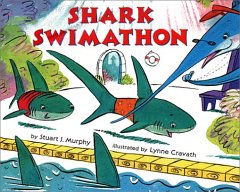
From School Library Journal Grade 1-3-The Ocean City Sharks swim team needs
money to attend swim camp. Fortunately, a local bank has promised to send them
if the sharks can swim a total of 75 laps by the end of the week. Each day,
Coach Blue subtracts the number of laps completed from the total, providing
examples of two-digit subtraction. Bright cartoons show a group of enthusiastic
sharks carrying book bags and wearing colorful bathing suits. The coach writes
the math problems out on a big sign and discusses each new subtraction, allowing
readers to follow along and cheer the team on. Regrouping is included, but the
concept of changing tens into ones is not fully explained. Still, this
entertaining story would work well as a supplement to lessons on two-digit
subtraction. Melinda Piehler, North Tonawanda Public Library, NY Copyright 2001
Reed Business Information, Inc. --This text refers to an out of print or
unavailable edition of this title. From Booklist Gr. 2-4. Like other books in
the MathStart series, this presents a mathematical concept in the framework of a
story. Here, a shark swim team practices subtraction of two-digit numbers as it
tries to reach a goal of 75 laps. The focus is on the subtraction, which gets
progressively more difficult as the predictable story goes on. Swordfish Coach
Blue explains the process in each example. Perceptive children will note that
the swimmers' performance improves with practice and that one shark uses
division to determine the number of laps each teammate must still swim. Lynne
Cravath's illustrations, in swimming-pool hues, feature amusing details and an
interesting assortment of sharks, from twin hammerheads to Tiny, the hair-bowed
whale shark. An appendix suggests activities to extend the lesson and includes a
list of other books with a subtraction theme. Sharks, sports, and subtraction--a
winning combination. Catherine Andronik Copyright © American Library
Association. All rights reserved --This text refers to an out of print or
unavailable edition of this title.
Shapes in Transportation
|
Shapes in Transportation
Author: Jennifer Rozines Roy
and Gregory Roy
ISBN:
LCCN:
Dewey:
Number:
|
Category:
User Rating: Pages: 0
Paperback Singapore Math/Marshall Cavendish
Seaweed Soup
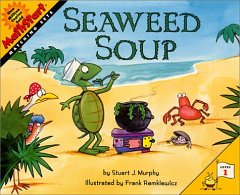 |
Seaweed Soup
Author: Murphy, Stuart J. Remkiewicz,
Frank (Illustrator) Remkiewicz, Frank
ISBN:
0-06-446736-8
LCCN: 99087634
Dewey: 511.3/22
21
Number:
|
Category:
Juvenile Mathematics
User Rating: 4.0 Stars
Pages:
40
Paperback HarperTrophy
From School Library Journal reS-Gr 2-Murphy's humorous text indirectly
teaches about sets as Turtle sits down to enjoy his thick green, gooey seaweed
soup. Each time unsuspecting friends come by, they are invited to lunch and
Turtle goes to his shelf to find extra place settings. When he runs out of an
item, he makes another set with substitutes. For instance, a jelly jar serves
for a cup, a toy shovel becomes a spoon, etc. Children will enjoy the story and
its surprising ending while learning about the concept. The bright watercolor
cartoons by the artist of "Froggy" fame lend a deft and humorous touch to the
proceedings. The last pages have tips for further fun with math, suggestions for
activities around the house, plus a short list of other stories with similar
concepts. Well worth considering. Judith Constantinides, formerly at East Baton
Rouge Parish Main Library, LA Copyright 2002 Cahners Business Information, Inc.
From Booklist Ages 3-5. In this level 1 MathStart book, Murphy introduces the
concepts of matching sets, or one-to-one-correspondence. On a sunny beach,
Turtle makes a batch of seaweed soup and invites his friends Crab, Sandpiper,
Seagull, and Clam to join him for lunch. One by one, his friends come to the
table, requiring Turtle to produce an additional place setting. The lunch is a
success, and at the close, Turtle produces another whole pot of the savory
stuff. Adults will want to read through this book before sharing it with
children so that they can guide discussion about Turtle's table-setting dilemma.
A graph will help children review what they've learned, and two pages of ideas
for extending the book are appended. Remkiewicz's appealing illustrations
encourage children to match sets and count items in each set. Kathy Broderick
Copyright © American Library Association. All rights reserved --This text refers
to the Hardcover edition.
Safari Park
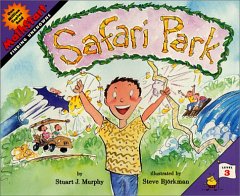 |
Safari Park
Author: Murphy, Stuart J. Bjorkman, Steve
(Illustrator) Bjorkman, Steve
ISBN:
0-06-446245-5
LCCN: 00063201
Dewey: 512.9/4
21
Number:
|
Category:
Juvenile Mathematics
User Rating: 4.0 Stars
Pages:
40
Paperback HarperTrophy
From School Library Journal Grade 2-3-Safari Park has just opened, and
Grandpa has 100 free tickets that he divides evenly among his five
grandchildren. With rides and games costing one, two, four, or six tickets each
and a treat costing one, careful planning and figuring are needed. Suddenly,
Paul realizes that he has lost his tickets, so the others must share theirs with
him. Each child's choices are discussed, with Paul being disappointed that he
doesn't have enough for the Terrible Tarantula. When given a ticket for the Rock
Toss, he carelessly participates in the game but wins 18 free tickets, and then,
on a repeat try, gets 18 more. Now everyone can ride the expensive Tarantula. A
two-page addendum suggests additional ways to use the book and its mathematical
concepts. The colorful but slightly garish cartoon illustrations add humor to
the necessary, but tedious, work of making choices within the restrictions of an
allotted budget. Good for a math lesson or independent reading, but too detailed
and involved for a read-aloud. Nancy A. Gifford, Schenectady County Public
Library, NY Copyright 2002 Reed Business Information, Inc. From Booklist Ages
6-9. From the MathStart series, this story begins with Grandpa taking his five
grandchildren to the opening of Safari Park. Though each child starts out with
20 free tickets for rides, Paul promptly loses his. Grandpa decrees that each
cousin must take Paul on a ride, which might take 2, 4, or 6 tickets. Other
treats, such as food and games, cost 1 ticket. As they go through the day,
intense mathematical calculations ensue as the kids figure out what they have
spent, how much is left, and how they can spend it. The math is worked out
visually on the pages, illustrated by lively, colorful ink-and-wash drawings.
Younger children may enjoy this picture book as one of the few taking place at
an amusement park; older students are more likely to take on the mathematical
challenges presented. As Murphy notes in the two appended pages of complementary
activities and suggested reading, this book offers experience in finding a
missing element, "an important step in the development of algebraic thinking."
Carolyn Phelan Copyright © American Library Association. All rights reserved
--This text refers to the Hardcover edition.
Room for Ripley
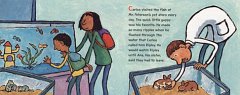 |
Room for Ripley
Author: Murphy, Stuart J. Wickstrom,
Sylvie (Illustrator) Wickstrom, Sylvie Wickstrom, Sylvie Kantorovitz
ISBN: 0-06-446724-4
LCCN: 98026109
Dewey:
530.8 21
Number:
|
Category: Physics
User Rating: 4.0 Stars
Pages:
40
Paperback HarperTrophy
From Library Journal Grade 2-4-Carlos figures out how much water it takes to
fill his fishbowl after he puts in gravel, a castle, and plants. The writing is
breezy and reads like a story about a boy who wants a pet, but the text
constantly reinforces the mathematical concepts (how many cups in a pint, a
quart, etc.). The illustrations are painted in muted primary colors against a
lot of white space. Suggested ways for adults to follow up on the concepts with
estimation, cooking, and shopping activities are included. A list of several
additional titles that present similar concepts is appended. A fun, painless
math lesson. Christine A. Moesch, Buffalo & Erie County Public Library, NY
Copyright 1999 Reed Business Information, Inc. From Kirkus Reviews PLB
0-06-027621-5 paper 0-06-446724-4 Room For Ripley (32 pp.; $15.95; PLB $15.89;
paper $4.95; Sept. 30; 0-06-027620-7; PLB 0-06-027621-5; paper 0-06- 446724-4)
Murphy (see review, above) ably conveys the role of volume in measurement for
this MathStart entry, but the story he uses as a vehicle is dull. Carlos wants
to buy a fish, which he has named Ripley, from the local pet shop. His sister
Ana helps him prepare a home for the guppy by filling a gallon fishbowl with
cups of water, all 16 of them. The insipid text isn't helped by the pictures;
while Wickstrom does a good job using a pyramid format to illustrate liquid
measurement, her characters's features are frozen and without expression. More
interesting for readers will be to deploy the tips at the end of the book
intended to enhance their understanding of capacity, e.g., estimating volume and
comparing the liquid amounts in various containers. (Picture book. 7-9) --
Copyright ©1999, Kirkus Associates, LP. All rights reserved. --This text refers
to an out of print or unavailable edition of this title.
A Remainder of One
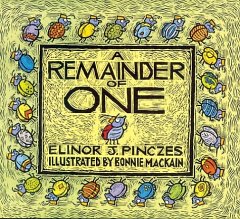 |
A Remainder of One
Author: Pinczes, Elinor J MacKain,
Bonnie (Illustrator) MacKain, Bonnie
ISBN:
0-618-25077-8
LCCN:
Dewey:
Number:
|
Category: Animal
stories
User Rating: 3.5 Stars
Pages: 32
Paperback Houghton Mifflin
From Publishers Weekly As they did in One Hundred Hungry Ants, Pinczes and
MacKain apply numerical division to a practical problem-and explain it in an
entertaining, visually emphatic way. Keeping to the insect theme, Pinczes
introduces the "25th Army Corps," a regiment of 25 beetles on parade. Their blue
bug queen "likes things tidy," and when the bugs march two by two, she notices
that one bug brings up the rear. The unfortunate Joe has to stand aside rather
than be a "remainder"; on the days that follow, Joe tries dividing the squadron
into symmetrical rows of three, then four and, finally, five, when he is at last
accommodated. Rather than endorse conformity, this rhyming tale focuses on Joe's
search for a solution. And lest squadron-like precision trouble readers, each
big-eyed "bug-soldier" has a unique patterned shell. MacKain even ensures that
the same beetle characters-one with a pointy nose, two wearing glasses,
etc.-appear in every spread, allowing readers to play spot-the-bug. Rendered in
dusty blues and pasture-green with warm yellow, red and pink accents, her
linocut-style art vibrates with energy. Ages 4-8. Copyright 1995 Reed Business
Information, Inc. --This text refers to the Hardcover edition. From School
Library Journal PreSchool-Grade 3?As they did in One Hundred Hungry Ants
(Houghton, 1993), Pinczes and MacKain present a mathematical concept through
rhyming text and simple illustrations. Here, an army of insects is planning a
parade, but each formation that the squadron comes up with for its 25
members?two lines of twelve, three of eight, four of six?leaves Joe Bug standing
alone, a remainder of one. After much cogitation, Joe finally comes up with the
solution: five lines of five. The rhyming has an old-fashioned tone reminiscent
of Peter Newell's books. MacKain's blue bugs are large, friendly looking, and
anthropomorphic. The queen has blonde curls. This will provide a fine
accompaniment to a math lesson on division. Children will identify with Joe's
predicament?being left out again and again?and will certainly have a clearer
understanding of remainders after reading this story.?Louise L. Sherman, Anna C.
Scott School, Leonia, NJ Copyright 1995 Reed Business Information, Inc. --This
text refers to the Hardcover edition.
Ready, Set, Hop!
 |
Ready, Set, Hop!
Author: Murphy, Stuart J. Buller,
Jon (Illustrator)
ISBN: 0-06-446702-3
LCCN:
Dewey:
Number:
|
Category: Juvenile Mathematics
User Rating: 4.0
Stars
Pages: 40
Paperback HarperTrophy
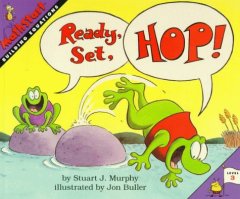
From School Library Journal Grade 1-3?This series entry flops as a
stand?alone title. Matty and Moe are two frogs who decide to have a contest to
see who can reach various spots with the fewest number of hops. Readers are
encouraged to count, add, and subtract along with them. There is no background
given for these skills; readers are expected to be able to understand the
transition between counting hops, figuring out which number is greater than or
less than the other, and translating these figures into a number problem.
Although there is a page of information at the back to help parents introduce
the concepts, it is not enough. The story frame is weak and will not hold
readers' interest long enough for them to care about which frog wins, and the
colorful cartoon illustrations can't save this no-hopper.?JoAnn Rees, Sunnyvale
Public Library, CA Copyright 1996 Reed Business Information, Inc. Product
Description Frog friends, Matty and Moe, are off with a "Ready, Set, Hop!" They
both made it to the rock, but who's in the lead? If Matty hopped 5 hops and Moe
hopped 2 more hops than Matty, then the score is 5 to 7. But then they're off
again. Any child who can add or subtract can build a simple equation, and Matty
and Moe make it fun. As readers count along with Stuart J. Murphy and Jon Buller
they will sharpen their problem solving skills and find out which frog is the
better hopper.
Racing Around
 |
Racing Around
Author: Murphy, Stuart J. Reed, Mike
(Illustrator) Reed, Mike HarperTrophy
ISBN:
0-06-446244-7
LCCN: 00056722
Dewey: 530.8
21
Number:
|
Category:
Juvenile Mathematics
User Rating: 4.0 Stars
Pages:
40
Paperback HarperTrophy
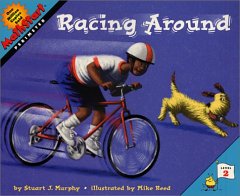
Product Description It's a long way around Perimeter Path! Mike's brother and
sister say he's too young to compete in the 15-kilometer bike race. But if Mike
just gets a chance, he knows he can make it all the way around. About the Author
Stuart J. Murphy is a visual learning specialist. A graduate of the Rhode Island
School of Design, he has a strong background in design and art direction. He
also has extensive experience in the world of educational publishing. Drawing on
all these talents, Stuart J. Murphy brings a unique perspective to the MathStart
series. In MathStart books, pictures do more than tell stories; they teach math.
Stuart J. Murphy and his wife, Nancy, live in Boston.
Rabbit's Pajama Party
 |
Rabbit's Pajama Party
Author: Murphy, Stuart J.
Remkiewicz, Frank (Illustrator) Remkiewicz, Frank Remkiewicz, Frank
ISBN: 0-06-446722-8
LCCN: 98036617
Dewey:
515/.24 21
Number:
|
Category: Early learning / early learning concepts
User
Rating: 4.0 Stars
Pages: 40
Paperback HarperTrophy
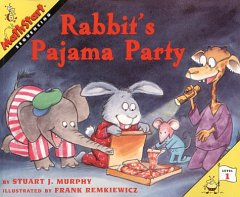
From School Library Journal PreSchool-Grade 1 A group of animals meet at
Rabbit's house for dinner and a sleepover. The friends eat pizza, make ice-cream
sundaes, get into pajamas, act a little silly, tell scary stories, and go to
sleep. This is a very simple approach to the concept of time sequencing. Young
children can identify food, clothing, animals, and colors; and there is just
enough familiar activity (sharing a meal, getting ready for bed) for them to
understand. The colors are bright and appealing, the cartoon artwork is simple
and uncluttered, and the print is large and clear for beginning readers. The
last two pages provide suggestions "For Adults and Kids" who want to explore the
math concept presented here. Susan Lissim, Dwight School, New York City
Copyright 1999 Reed Business Information, Inc. From Kirkus Reviews PLB
0-06-027617-7 paper 0-06-446722-8 New to the MathStart series is this quick take
on sequencing, although almost any story with a beginning, middle, and end would
serve as well. A sleepover is the premise; Rabbit invites his friends Mouse,
Giraffe, and Elephant to the party. The action is described in a few short
rhyming sentences that outline the order of events. Friends are invited inside,
a pizza dinner is gobbled up, juice follows dinner, and ice cream sundaes for
dessert conclude the meal. At bedtime, the four friends pull on their pajamas
and zip themselves into sleeping bags while Rabbit's mother takes a picture.
Hand shadows and scary stories come with lights out, until Mouse is heard
snoring peacefully. Just when it appears that it may be a stretch to locate the
math involved, a final page asks, ``What Happened at Rabbit's Pajama Party?'' to
prompt children to think about what happened first, next, and last. Although
Remkiewicz wiggles out of showing ``hot fudge'' by present a bottle of chocolate
syrup instead, no one will question the accuracy of his animals' zeal; they are
all smiles, delightfully displaying silly expressions. Characteristically, the
final spread offers tips and suggestions for adults who may want to extend the
sequencing concept with follow-up activities. (Picture book. 2-4) -- Copyright
©1999, Kirkus Associates, LP. All rights reserved. --This text refers to the
Hardcover edition.
Quilting Now & Then
 |
Quilting Now & Then
Author: Willing, Karen B.
Dock, Julie Bates Morse, Sarah (Illustrator)
ISBN:
0-9641820-1-7
LCCN:
Dewey:
Number:
|
Category: Children's
4-8
User Rating: 5.0 Stars
Pages: 36
Paperback Now & Then Publications
Probably Pistachio
 |
Probably Pistachio
Author: Murphy, Stuart J. Winborn,
Marsha (Illustrator)
ISBN: 0-06-446734-1
LCCN:
99027695
Dewey: 519.2 21
Number:
|
Category:
Fiction
User Rating: 4.5 Stars
Pages: 40
Paperback HarperTrophy
From School Library Journal Gr 1-2-Jack is having a bad day. Everything goes
wrong, from his alarm clock not going off in the morning to his futile hopes of
pizza for dinner. The word "probably" is used several times, along with related
possibilities, like "usually" and "sometimes." Even though the coach "nearly
always" chooses teams a certain way, today he changes his method, and Jack and
his friend are separated. With an "even chance" that Mom brought home his
favorite ice cream, she pulls out his sister's favorite (but she also had his
favorite in the bag). The cartoon illustrations extend the narrative, showing
some activities not mentioned in the text, such as Jack spilling milk on his
homework. Characters react to the action in dialogue balloons, and the
protagonist's thought processes are shown as well. Winborn's characters have
excellent facial expressions and Jack's dog has a personality of its own. While
Judith Viorst gave readers the classic version of a truly bad day with Alexander
and the Terrible, Horrible, No Good, Very Bad Day (Atheneum, 1972), Murphy uses
it to illustrate probability instead.-Sharon R. Pearce, Geronimo Public School,
OK Copyright 2001 Cahners Business Information, Inc. From Booklist Ages 6-8.
"With Mom, Mondays mean it's probably pastrami. And pastrami is my favorite food
in the whole world." Unfortunately for Jack, it's Dad's turn to fix lunch, and
that's just the beginning of a bad day. In this MathStart entry, Stuart
introduces the concept of probability. As Jack moves through his day, he makes a
series of predictions based on good reasoning. As he thinks through the
likelihood of each situation turning out in his favor, his thoughts appear in a
cloud-shaped bubble above his head. Winborn's watercolors playfully depict
Jack's misery as things go from bad to worse, until his bad luck finally ends
when Mom brings home his favorite dessert, pistachio ice cream. As in Missing
Mittens and other series titles, a closing section has follow-up activities to
extend and enrich the lesson, as well as a short list of books with related
themes. Lauren Peterson Copyright © American Library Association. All rights
reserved --This text refers to an out of print or unavailable edition of this
title.
Polly's Pen Pal
 |
Polly's Pen Pal
Author: Murphy, Stuart J. Simard,
Remy (Illustrator) Simard, Remy
ISBN:
0-06-053170-3
LCCN: 2003027526
Dewey: 516/.15
22
Number:
|
Category:
Juvenile Mathematics
User Rating: 3.5 Stars
Pages:
40
Paperback HarperTrophy
Product Description Polly's pen pal, Ally, is 125 centimeters tall, weighs 25
kilograms, and lives 450 kilometers away -- and Polly is determined to find a
way to visit her! A story of long-distance friendship introduces basic metric
measurements to children. About the Author Stuart J. Murphy is a visual learning
specialist. A graduate of the Rhode Island School of Design, he has a strong
background in design and art direction. He also has extensive experience in the
world of educational publishing. Drawing on all these talents, Stuart J. Murphy
brings a unique perspective to the MathStart series. In MathStart books,
pictures do more than tell stories; they teach math. Stuart J. Murphy and his
wife, Nancy, live in Boston.
Pepper's Journal: A Kitten's First Year
 |
Pepper's Journal: A Kitten's First Year
Author:
Murphy, Stuart J. Winborn, Marsha (Illustrator) Winborn, Marsha
ISBN: 0-06-446723-6
LCCN: 98047523
Dewey:
[E] 21
Number:
|
Category: Numbers & counting
User Rating: 5.0
Stars
Pages: 40
Paperback HarperTrophy
From School Library Journal Kindergarten-Grade 2-The excitement begins when
Grandma's cat, Snowy, gives birth to three kittens. One will soon belong to her
grandchildren, Joey and Lisa. To prepare herself, Lisa goes to the library and
checks out every book on kittens. She learns that when newborn, these creatures
weigh three ounces. One week later, the kittens open their eyes. Two months must
pass before the children can take Pepper, the chosen animal, home. In an
entertaining journal format, readers observe Pepper's growth over the next year
and learn all of the important details of cat care and cat behavior. The concept
of time is fully integrated into the story. A monthly calendar appears on each
double-page spread showing the progression of days, weeks, and months. Winborn's
full-color animated paintings give readers lots to examine and enjoy. A unique
complement to most collections. Jackie Hechtkopf, University of Maryland,
College Park Copyright 2000 Reed Business Information, Inc. From Kirkus Reviews
PLB 0-06-027619-3 paper 0-06-446723-6 This entry in the MathStart series
investigates the concepts of calendar time through the events of a kitten's
first year. Lisa's agreeable, first-person journal keeps track of important
datesthe birth of the litter at Grandma's, Lisa and younger brother Joey's first
visit to the week-old kittens, permission to keep a newborn kitten when it is
ready to leave its mother, selecting and naming a kitten at when it is
one-month-old, taking Pepper home at two months, and so on to Pepper's first
birthday. These milestones appear in attractively busy spreads that show the
progression of Lisa's family life on the left and Lisa's journal of Pepper's
progress on the right. Many scenes will provoke smiles: Thanksgiving in November
finds Pepper under the family's table, tugging at an eight-month-old cousin's
blanket, while Lisa's journal drawings show her reading Pepper his favorite
book, Puss in Boots, as he rests on her quilt. The recurring monthly calendar
highlights important dates; in this well-done book, readers also learn harder
facts about what a growing cat needs and doesintegral, everyday, and useful
information presented in a way that reinforces notions about the passing of time
as well as the functions of a calendar. (Picture book. 6-9) -- Copyright ©2000,
Kirkus Associates, LP. All rights reserved. --This text refers to an out of
print or unavailable edition of this title.
Patterns in Nature
|
Patterns in Nature
Author: Jennifer Rozines Roy and
Gregory Roy
ISBN:
LCCN:
Dewey:
Number:
|
Category:
User Rating: Pages: 0
Paperback Singapore Math/Marshall Cavendish
The Patchwork Quilt
 |
The Patchwork Quilt
Author: Flournoy, Valerie
Pinkney, Jerry (Illustrator) Pinkey, Jerry Pinkey, Jerry
ISBN:
0-8037-0097-0
LCCN: 84001711
Dewey: [E]
19
Number:
|
Category:
Juvenile Fiction
User Rating: 4.5 Stars
Pages: 32
Hardcover Dial
School Library Journal, starred review This story will leave children moved
and satisfied. Review This story will leave children moved and satisfied.
(School Library Journal, starred review) Pinkney interprets the story with warm
family scenes that glow. (Booklist)
A Pair of Socks
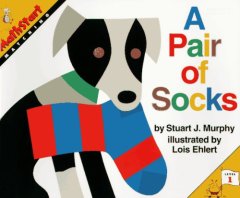 |
A Pair of Socks
Author: Murphy, Stuart J. Ehlert,
Lois (Illustrator)
ISBN: 0-06-446703-1
LCCN:
Dewey:
Number:
|
Category: Juvenile Mathematics
User Rating: 4.5
Stars
Pages: 40
Paperback HarperTrophy
From Booklist Ages 3^-6. Perhaps the only picture-book story told from the
point of view of a sock, this details the search for the other half of the pair.
The striped sock searches laundry bag, washer, and dryer in vain, finally
discovering its mate in the dog's basket. Short, snappy rhymes and Ehlert's
brilliantly colored collage illustrations combine to make this tale from the
MathStart series an entertaining book. Teachers and lesson-minded parents will
appreciate the activities and books suggested to extend the learning about
pairs, patterns, and differences. Carolyn Phelan --This text refers to an out of
print or unavailable edition of this title. Product Description Does a
polka-dotted sock match a striped sock? Young children will learn about
matching, an important early math skill, as a lonely striped sock searches the
house for its mate. They will may even be inspired to practice this skill in
their own sock drawers! Best Children's Science Books 1997 (Science
Books and Films)
One...Two...Three...Sassafras!
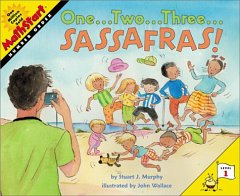 |
One...Two...Three...Sassafras!
Author: Murphy, Stuart
J. Wallace, John (Illustrator) Wallace, John
ISBN:
0-06-446246-3
LCCN: 00054033
Dewey: 515/.24
21
Number:
|
Category:
Juvenile Mathematics
User Rating: 4.0 Stars
Pages:
40
Paperback HarperTrophy
Product Description One䓷o䓨ree䒡ssafras! (LEVEL 1: Number Order) It's the
Lumpkin family reunion, and Uncle Howie is ready with his camera. All the
cousins have to line up by age for their picture. But just as they are ready to
say, ⒡ssafras!⟳omething goes wrong every time! This picture–perfect tale of
family fun illustrates the important math concept of number order. Ages 3+ Card
catalog description At a family reunion, the cousins line up in order of their
ages to get their pictures taken, introducing the concept of numerical order.
--This text refers to an out of print or unavailable edition of this title.
One, Two, Buckle My Shoe
|
One, Two, Buckle My Shoe
Author: Yeap Ban Har
ISBN:
LCCN:
Dewey:
Number:
|
Category: User
Rating: Pages: 0
Paperback Marshall Cavendish/Singapore Math
One, Two, Buckle mMy Shoe
|
One, Two, Buckle mMy Shoe
Author: Yeap Ban Har
ISBN:
LCCN:
Dewey:
Number:
|
Category: User
Rating: Pages: 0
Paperback Marshall Cavendish/Singapore Math
Numbers on the Street
|
Numbers on the Street
Author: Jennifer Rozines Roy
and Gregory Roy
ISBN:
LCCN:
Dewey:
Number:
|
Category:
User Rating: Pages: 0
Paperback Singapore Math/Marshall Cavendish
My Grandmother's Patchwork Quilt
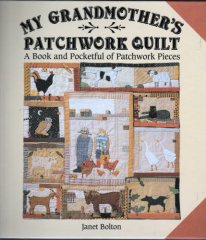 |
My Grandmother's Patchwork Quilt
Author: Bolton, Jane
ISBN: 0-385-31155-9
LCCN: 93017279
Dewey:
746.9/7 20
Number:
|
Category: Crafts & Hobbies
User Rating: 5.0
Stars
Pages: 1
Hardcover Doubleday Books for Young Readers
From Publishers Weekly Quilting how-to combines with a straightforward
growing-up-on-the-farm tale to produce this picture book about a bygone bit of
Americana. Grandmother presents her girlhood dolls' quilt to her granddaughter,
the book's narrator, setting in motion a twofold story. On the left of each
spread, the narrator chronicles the making of the quilt ("Grandmother drew
pictures on paper of the different animals she wanted to sew"). On the right--in
a different typeface--Grandmother tells of her daily farm routine ("Our two
geese lived in the yard outside the back door"), each episode highlighted by a
closeup view of a patchwork square. (The squares can be seen falling into place
on a depiction of the quilt on the lefthand pages.) The book's final spread
consists of a gatefold, with a large reproduction of the finished quilt and a
historical note presented opposite a pocket containing fabric patterns for a
doll's quilt and simple instructions. Bolton's commendable effort appears
overcrowded, as if attempting too much in this necessarily brief format. Also,
her subdued colors seem even less vibrant against the book's cream-colored
pages. All ages. Copyright 1994 Reed Business Information, Inc. Card catalog
description Alternating pages describe a young girl's life on a farm and how she
made a patchwork quilt to capture memories of that life. Includes patterns and
instructions for making a similar quilt.
Mummy Math: An Adventure in Geometry
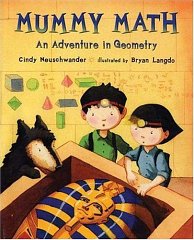 |
Mummy Math: An Adventure in Geometry
Author:
Neuschwander, Cindy Langdo, Bryan (Illustrator)
ISBN:
0-8050-7505-4
LCCN: 2004009200
Dewey: 516
22
Number:
|
Category:
Juvenile Nonfiction
User Rating: 4.5 Stars
Pages: 32
Hardcover Henry Holt and Co.
From School Library Journal Grade 1-4–Matt and Bibi go to Egypt with their
scientist parents in search of an ancient pharaoh's mummy. When the siblings are
accidentally shut in the pyramid, they decide to explore. Using hieroglyphic
clues, they discover that the path to the mummy is delineated by "faces," the
flat surfaces of geometric solids. As they find either pictures of solid shapes
or the objects themselves, the twins count the faces of the shapes and are
guided through the pyramid by relating their answers to the hieroglyphic clues.
They find the mummy and a map indicating the way out. Although this book
attempts to provide an introduction to solid geometry, the information is not
clearly presented. The colorful impressionist cartoons depict the various shapes
discussed in the text, but they are not labeled. The plot itself is a stretch:
before they leave for Egypt, Bibi says she hopes to learn about hieroglyphics,
but as soon as she arrives there, she is expert enough to interpret complex
messages. An endnote lists some good activities to help children learn about
geometric solids, but the story will leave readers more confused than
enlightened. Try Stuart J. Murphy's Captain Invincible and the Space Shapes
(HarperCollins, 2001) and Tana Hoban's Cubes, Cones, Cylinders, & Spheres
(Greenwillow, 2000) for better introductions to this topic.–Lynda Ritterman,
Atco Elementary School, Waterford, NJ Copyright © Reed Business Information, a
division of Reed Elsevier Inc. All rights reserved. Product Description Matt,
Bibi, and their dog Riley crawled through the tiny opening first. FWUMP! A
secret door suddenly closed behind them . . . Matt and Bibi use math to escape
from a pharaoh's tomb! When the Zills family is summoned to Egypt to help find
the hidden burial site of an ancient pharaoh, Matt and Bibi are locked into an
adventure they did not expect. Stuck inside a pyramid with only each other,
their dog Riley, and geometric hieroglyphics to help them find their way, the
twins must use their math knowledge to solve the riddles on the walls and locate
the burial chamber. Luckily, the two know their stuff when it comes to geometric
solids.
Multiplication on the Farm
|
Multiplication on the Farm
Author: Jennifer Rozines
Roy and Gregory Roy
ISBN:
LCCN:
Dewey:
Number:
|
Category:
User Rating: Pages: 0
Paperback Singapore Math/Marshall Cavendish
More Than One
 |
More Than One
Author: Schlein, Miriam Crews, Donald
(Drawings)
ISBN: 0-590-10734-8
LCCN:
Dewey:
Number:
|
Category: Concepts - General
User Rating: 4.5
Stars
Pages: 0
Paperback Scholastic
From Publishers Weekly Budding Noam Chomskys may be disappointed that this
book doesn't address the linguistic question of why singular nouns can refer to
groups of things or people. Just about everyone else, however, is certain to
enjoy how these two veterans of children's literature show that "one can be more
than one." Schlein's (I Sailed with Columbus) text is simple but always playful,
whether she's explaining that "a pair of shoes is always two," or using the
various permutations of a family to show that "one can be different, different
every time." Caldecott Honor artist Crews's (Freight Train) watercolor and
gouache illustrations have an airy, often impressionistic feel that works well
with Schlein's non-pedantic approach?although he displays a surer hand in
depicting nature (a flock of birds, a school of fish) than in rendering people.
Ages 4-up. Copyright 1996 Reed Business Information, Inc. --This text refers to
the Hardcover edition. From School Library Journal PreSchool-Grade 2-In this
concept book, readers learn that one can be more than one, as when "one pair of
shoes is two shoes." Throughout the book, this idea is expanded upon to show
that the number one can represent other numbers. The colorful watercolor and
gouache artwork clearly illustrates each concept as it is introduced. People of
various races and ages obviously enjoy one another's company and help make
mathematically abstract ideas more concrete. More Than One is more than the
usual counting book and is an enjoyable, accessible introduction to the world of
numbers. Elizabeth Trotter, Scott County Public Library, Georgetown, KY
Copyright 1996 Reed Business Information, Inc. --This text refers to the
Hardcover edition.
More or Less
 |
More or Less
Author: Murphy, Stuart J. Wenzel, David
T. (Illustrator) Wenzel, David T.
ISBN:
0-06-053167-3
LCCN: 2003027847
Dewey: 513
22
Number:
|
Category:
Juvenile Mathematics
User Rating: 5.0 Stars
Pages:
40
Paperback HarperTrophy
From Booklist Gr. 1-3. The concept of comparing numbers gets Murphy's
signature MathStart treatment--by turns amusing and teaching. In this story,
Eddie works the "guess the age" booth at the fair. Blindfolded, he listens to a
contestant's voice, and if he guesses a person's age "after three questions or
less," he wins. The contestant gets a prize if Eddie has to ask four or more
questions. If Eddie hasn't guessed after six tries, he gets dunked in a pool.
The way Eddie progresses (he arrives at his answers by narrowing his guess to a
number more than or less than another number) leads children into the world of
logical, educated guesses. A subplot about a girl trying to win a prize cleverly
ties into the main story. Youngsters who need to understand the math concept in
more depth will find several activities at the conclusion of the book. These are
meant to be done with help from adults, to whom the back matter is directed.
Sprightly watercolor artwork makes math look like fun. Ilene Cooper Copyright ©
American Library Association. All rights reserved --This text refers to the
Hardcover edition. Product Description Is your age more than 5? Is it less than
10? Eddie's got to guess. And he doesn't want to be wrong! Eddie has a booth at
the school fair, guessing people's ages. He hasn't guessed wrong yet, but if he
does, he gets dunked. Can Eddie keep guessing right -- and keep from getting
wet? Comparing whole numbers and understanding what's more and what's less are a
big part of Eddie's strategy, and an important math skill for young readers to
learn.
More Bugs? Less Bugs?
 |
More Bugs? Less Bugs?
Author: Curry, Don L. Kaufman,
Johanna Kaufman, Johanna
ISBN: 0-7368-7037-7
LCCN:
99052181
Dewey: 513.2/11 21
Number:
|
Category: Preschool
Concepts
User Rating: 5.0 Stars
Pages: 32
Library Binding Capstone Press
Children's Literature This is a simple addition and subtraction that focuses
on insects. Bees add up to five, starting with one plus one. Ladybugs are
counted by twos, stopping at ten. Then there is a problem¾the author states that
he is about to count damselflies, but a dragonfly is in most of the photographs.
He starts with five insects and subtracts one in each picture until he is left
with one. (Why not zero?) Then twelve butterflies fly away in pairs until there
are none left. Finally, summary sheets starting with zero add one more
treehopper to reach five, or two more beetles to reach ten, or subtract from
five planthoppers one at a time, or from ten, pairs of wasps, reaching zero in
both cases. A concluding note to parents and teachers includes two hands-on
projects. Internet sites, "books about bugs," a glossary full of information
about the insects and an index follow. Shouldn't the title be "More Bugs? Fewer
Bugs?" This is an entry in the "A+ Books" series. 1999, Capstone Curriculum,
$21.00. Ages 4 to 7. Reviewer: Candace Deisley Annotation Simple text and
photographs present the adding and subtracting of a variety of bugs. Children's
Literature This is a simple addition and subtraction that focuses on insects.
Bees add up to five, starting with one plus one. Ladybugs are counted by twos,
stopping at ten. Then there is a problem¾the author states that he is about to
count damselflies, but a dragonfly is in most of the photographs. He starts with
five insects and subtracts one in each picture until he is left with one. (Why
not zero?) Then twelve butterflies fly away in pairs until there are none left.
Finally, summary sheets starting with zero add one more treehopper to reach
five, or two more beetles to reach ten, or subtract from five planthoppers one
at a time, or from ten, pairs of wasps, reaching zero in both cases. A
concluding note to parents and teachers includes two hands-on projects. Internet
sites, "books about bugs," a glossary full of information about the insects and
an index follow. Shouldn't the title be "More Bugs? Fewer Bugs?" This is an
entry in the "A+ Books" series. 1999, Capstone Curriculum, $21.00. Ages 4 to 7.
Reviewer: Candace Deisley
Monster Musical Chairs
 |
Monster Musical Chairs
Author: Murphy, Stuart J.
Nash, Scott (Illustrator) Nash, Scott
ISBN:
0-06-446730-9
LCCN: 99027902
Dewey: 513.2/12
21
Number:
|
Category:
Numbers & counting
User Rating: 5.0 Stars
Pages:
40
Paperback HarperTrophy
From School Library Journal K-Gr 1-In this book about subtraction, written in
couplets with a beat as definite as that of the rock band supplying the music,
six smiling monsters are engaged in an animated game of musical chairs. The
action begins when the little creatures forcefully throw chairs across the room,
telling everybody to "duck." The game proceeds with chairs and monsters being
eliminated one by one. The characters' heads are pictured in a vertical row
along the outside edge of the right-hand pages, with an X over the one that was
unseated in that round. Unfortunately, the order of the heads varies from page
to page, muddling the subtraction concept. Starting with an unequal number of
chairs and monsters, subtracting one from each group simultaneously, and finally
ending with one chair and one monster may be very confusing to young children.
The most valuable part of this book is the list of suggested extension
activities at the end. Pat Brisson's Benny's Pennies (Bantam, 1995) and Eileen
Christelow's Five Little Monkeys Sitting in a Tree (Clarion, 1991) are more to
the point.-Lynda Ritterman, Atco Elementary School, NJ Copyright 2001 Cahners
Business Information, Inc. From Booklist Ages 3-5. Lovable monsters provide a
fun way for youngsters to learn subtraction in this latest entry in the
MathStart series. The lively text and animated artwork are a good match for the
young audience. Murphy uses bouncy rhymes and simple sentence structure to
describe how the musical chairs game works: "Six fuzzy monsters want a seat--see
them rock to a monster beat. Five monster chairs all in a line. Sit in one and
you'll be fine!" Meanwhile, Nash's silly pictures show the monsters in action,
taking care to clearly depict the correct number of monsters and chairs for
counting practice. Youngsters will love to join in the rollicking refrain:
"Stomp, stomp, SNORT. Shake shimmy, SHOUT! When the music stops, one monster is
OUT!" Faces of the monsters remaining after each round are pictured in a narrow
column on the far right side of each double-page spread. Two pages of simple
extension activities are also included. Lauren Peterson Copyright © American
Library Association. All rights reserved --This text refers to an out of print
or unavailable edition of this title.
Money at the Store
|
Money at the Store
Author: Jennifer Rozines Roy and
Gregory Roy
ISBN:
LCCN:
Dewey:
Number:
|
Category:
User Rating: Pages: 0
Paperback Singapore Math/Marshall Cavendish
Missing Mittens
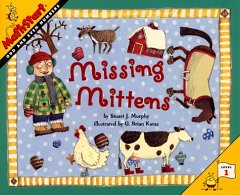 |
Missing Mittens
Author: Murphy, Stuart J. Karas, G.
Brian (Illustrator)
ISBN: 0-06-446733-3
LCCN:
Dewey:
Number:
|
Category: Early learning / early learning concepts
User
Rating: 4.0 Stars
Pages: 40
Paperback HarperTrophy
From School Library Journal Kindergarten-Grade 1-This appealing addition to
the series introduces odd and even numbers. When Farmer Bill dresses for outdoor
chores on a snowy day, he discovers that he is short one mitten, and "One
mitten's not a pair." Proceeding with his work, the farmer soon learns that his
cow has the same dilemma. "They looked for her four mittens,/but there were only
three." Predictably, the situation escalates. His three chickens have only five,
and his two horses have only seven. Finally, Farmer Bill and his animal
entourage spot the cause of their problem; it's a mitten-chewing goat. Artfully
enhanced by Karas's amusing illustrations, the rhyming text bounces along
smoothly. With spectacles perched on the tip of his nose, Farmer Brown wears a
comically perplexed look on his face. Colorful borders and warm background
colors provide a nice balance to the snowy scenes. Charts help to show the
difference between the number of mittens found (odd) and the number needed
(even). As in other entries in the series, suggestions for additional activities
to extend the math concept are included. This well-executed title works well
with or without the math; use it to clarify a concept or read it aloud as an
enjoyable winter romp. Alicia Eames, New York City Public Schools Copyright 2001
Reed Business Information, Inc. From Booklist Ages 4-7. Farmer Bill is missing a
mitten, leaving him with one "odd" mitten instead of an "even" two. His cow is
also missing one of her four mittens, leaving her with an odd three. His
chickens and horses have the same problem. Finally, they discover the thief,
recover their mittens, and dry them by the fire. The awkwardly rhymed text is
true doggerel, but it does invite participation and introduces the concept of
odds and evens in an amusing way. Karas' delightfully droll illustrations not
only clarify the concepts but also they give personality to Farmer Bill and his
barnyard crew. An appended list, directed to adults, suggests follow-up
activities and books. More successful as a teaching tool than a story, this will
enhance math lessons at home and in the classroom. Linda Perkins Copyright ©
American Library Association. All rights reserved --This text refers to an out
of print or unavailable edition of this title.
Mighty Maddie
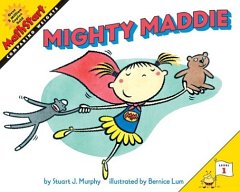 |
Mighty Maddie
Author: Murphy, Stuart J. Lum, Bernice
(Illustrator) Lum, Bernice
ISBN: 0-06-053161-4
LCCN:
2003017610
Dewey: 389/.1 22
Number:
|
Category:
Mathematics
User Rating: 3.0 Stars
Pages: 40
Paperback HarperTrophy
From School Library Journal PreSchool-Grade 1–A basic story that teaches
comparative weights. Madeline picks up her toys in preparation for her fifth
birthday party. As her father helps her, they discuss heavy versus light. Dad
gathers the hefty items such as a box of books and a full piggy bank, while
Maddie moves a pillow and stuffed animal. The array of gender-mixed playthings
scattered throughout the house includes trucks, art supplies, and a dollhouse.
"You have to do the rest," says Dad when all the toys are in her room, whereupon
the caped figure of "Mighty Maddie" springs into action. A surprise ending shows
that Madeline is a bright child who knows what to do in a hurry. Childlike line
drawings with bright colors give readers a sense of action. This appealing book
has uses beyond the math concept, and offers messages about family life,
self-image, and responsibility.–Erlene Bishop Killeen, Fox Prairie Elementary
School, Stoughton, WI Copyright © Reed Business Information, a division of Reed
Elsevier Inc. All rights reserved. --This text refers to an out of print or
unavailable edition of this title. Product Description Maddie's room is a mess.
Maddie's toys are everywhere. And Maddie has to clean them up before her
birthday party starts. This looks like a job for ... MIGHTY MADDIE! Faster than
a speeding bullet, more powerful than a vacuum cleaner, Mighty Maddie, the
room-cleaning superhero, gives readers a playful lesson about the difference
between light and heavy.
Measuring at Home
|
Measuring at Home
Author: Jennifer Rozines Roy and
Gregory Roy
ISBN:
LCCN:
Dewey:
Number:
|
Category:
User Rating: Pages: 0
Paperback Singapore Math/Marshall Cavendish
Math-A-Pedia: Primary
|
Math-A-Pedia: Primary
Author: Brummett, David C.
ISBN: 0-201-84120-7
LCCN:
Dewey:
Number:
|
Category:
User Rating: 4.5 Stars
Pages: 96
Hardcover Pearson Prentice Hall
Let's Fly a Kite
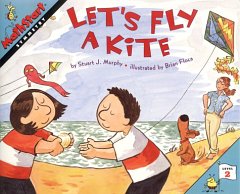 |
Let's Fly a Kite
Author: Murphy, Stuart J. Floca,
Brian (Illustrator)
ISBN: 0-06-446737-6
LCCN:
99026550
Dewey: 512.9/24 21
Number:
|
Category:
Fiction
User Rating: 3.5 Stars
Pages: 40
Paperback HarperTrophy
From School Library Journal Grade 1-3-Bob and Hannah argue over everything
during their day at the beach-how to decorate the kite they are going to fly,
sharing the backseat of the car, who gets the last sandwich, and who sits where
on the beach towel. Their resourceful baby-sitter finds a solution to each
problem using the concept of symmetry. Floca's watercolor-and-ink-line cartoons
enhance the story and ably depict the method used to divide everyday objects
into two equal parts. Examples of nonsymmetry are shown in each situation (e.g.,
dividing the kite horizontally so that the bottom half is larger), thus adding
to the story's conflict and encouraging a better understanding of the concept.
The book would work best as a read-aloud to start or supplement a lesson on
symmetry. Follow-up activities are appended. Teachers and students will
appreciate this useful book. Toni D. Moore, Simon Kenton High School,
Independence, KY Copyright 2000 Reed Business Information, Inc. Product
Description
Let's Fly a KiteWhen Bob and Hannah split something, the two
pieces had better be symmetrical--exactly the same. BUt to fly their kite,
they'll have to learn something new--cooperation!
Let's Find Out About Money
 |
Let's Find Out About Money
Author: Barabas, Kathy
Swann, David
ISBN: 0-590-73803-8
LCCN:
96044077
Dewey: 332.4 21
Number:
|
Category:
General
User Rating: 5.0 Stars
Pages: 24
Paperback Scholastic
Card catalog description Text and photographs depict the process of making
money, from ores to finished coins.
Less Than Zero
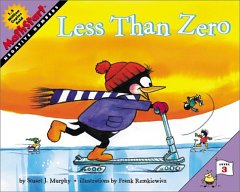 |
Less Than Zero
Author: Murphy, Stuart J. Remkiewicz,
Frank (Illustrator) Remkiewicz, Frank
ISBN:
0-06-000126-7
LCCN: 2002020732
Dewey: 513
21
Number:
|
Category:
Juvenile Mathematics
User Rating: 4.0 Stars
Pages:
40
Paperback HarperTrophy
Product Description Perry the Penguin needs 9 clams to buy an ice scooter --
but he's not very good at saving. As Perry earns, spends, finds, loses, and
borrows clams, a simple line graph demonstrates the concept of negative numbers.
Card catalog description While trying to save enough money to buy a new ice
scooter, Perry the Penguin learns about managing his money and about negative
numbers. --This text refers to the Hardcover edition.
Lemonade for Sale
 |
Lemonade for Sale
Author: Murphy, Stuart J. Tusa,
Tricia (Illustrator)
ISBN: 0-06-446715-5
LCCN:
96052063
Dewey: 001.4/226 E 21
Number:
|
Category:
Mathematics
User Rating: 5.0 Stars
Pages: 40
Paperback HarperTrophy
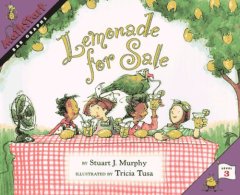
From School Library Journal Grade 1-3AFour children decide to sell lemonade
to make money to fix their clubhouse. For three days, they keep a bar graph to
track their sales. It shows a steady increase and then a noticeable drop. After
finding out that the competition is a new kid juggling down the street, they ask
him to perform beside the stand and sales increase "over the top." The humorous
and colorful illustrations will appeal to young children, but they may not be
ready for the concept of bar graphs. Older children interested in learning about
them are likely to find the book too young in appearance and story line. A
two-page appendix is included "For Adults and Kids" who need additional ideas
for using this book. The math lesson is heavy-handed, and the target audience
questionable. However, this one has the advantage of competently done, amusing
illustrations.ANancy A. Gifford, Schenectady County Public Library, NY Copyright
1998 Reed Business Information, Inc. Kirkus Reviews, pointered review "A winning
way to make some basic concepts and techniques less intimidating."
Leaping Lizards
 |
Leaping Lizards
Author: Murphy, Stuart J. Adinolfi,
Joann (Illustrator) Adinolfi, Joann
ISBN:
0-06-000132-1
LCCN: 2004022470
Dewey: 513.2/11
22
Number:
|
Category:
Juvenile Mathematics
User Rating: 1.0 Stars
Pages:
40
Paperback HarperTrophy
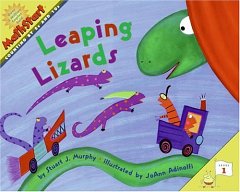
From Booklist PreS-K. Part of the ongoing Math Start series, which offers
math concepts in picture-book format for a variety of levels, this book
introduces the multiples of five, as lizards of different colors travel through
the pages on unicycles, a hot-air balloon, an airplane, and other modes of
transport, while a green snake looks on. Finally, the number 50 is reached, and
lizards explode in all directions. Written in short couplets, the simple text
describes the ever-increasing number of lizards, but the highlight of the book
is the effective design. An intelligent blending of white space and colors make
each double-page spread visually stand out. A box on one side of each page helps
children keep track of the multiplying lizards, and a closing section offers
adults a few more ideas for easy math education. Todd Morning Copyright ©
American Library Association. All rights reserved --This text refers to the
Hardcover edition. Product Description Stuart J. Murphy travels all over the
UnitedStates talking to thousands of kids. And you'll never believe what they
talk about: MATH! Stuart shows kids that they use math every day -- to share a
pizza, spend their allowance, even sort socks. Stuart writes funny stories about
math -- and if you read his books, you'll start to see the fun in math, too.
Leaping Lizards The show's about to begin -- but where are all the lizards?
Slowly they start to arrive in groups of 5 and 10. Will all 50 make it in time?
An introduction to counting by 5s and 10s.
The Keeping Quilt
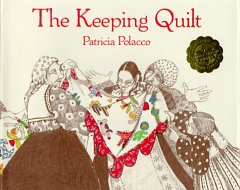 |
The Keeping Quilt
Author: Polacco, Patricia Polacco,
Patricia
ISBN: 0-671-64963-9
LCCN:
88004507
Dewey: [E] 19
Number:
|
Category: Early learning
/ early learning concepts
User Rating: 4.5 Stars
Pages:
32
Hardcover Simon & Schuster Children's Publishing
From Publishers Weekly This 10th-anniversary edition of Polacco's family
story about a quilt made from an immigrant Jewish family's clothing from their
Russian homeland "adds a few squares to the original story with expanded text
and art," noted PW. Ages 4-8. (May) Copyright 2001 Reed Business Information,
Inc. --This text refers to the Paperback edition. From School Library Journal
PreSchool-Grade 2 Polacco's first-person voice moves her narrative forward
gracefully from the time when her Great-Gramma Anna came to America during the
last century to the present. Richly detailed charcoal drawings fill the pages of
this beautifully conceived book. Particularly striking are the faces of the
Russian Jewish immigrant families who people the pages. The only color used is
in the babushka and dress of Great-Gramma Anna, which become part of a brightly
hued quilt. Following that quilt through four generations is the basis of this
account. Customs and fashions change, but family is constant, visually linked by
the ``keeping quilt.'' Children will be fascinated by the various uses to which
the quilt is put, although some of those uses make one wonder how its
``like-new'' shape was maintained. That stretch of the imagination is gentle,
however, and does not mar the story. Readers who notice that the author and the
narrator share the same name may realize that this lovely story is true; that
should make it even more appealing. Lee Bock, Brown County Public Libraries,
Green Bay, Wis. Copyright 1988 Reed Business Information, Inc.
Just Enough Carrots
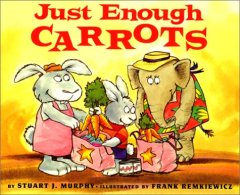 |
Just Enough Carrots
Author: Murphy, Stuart J.
Remkiewicz, Frank (Illustrator) Remkiewicz, Frank
ISBN:
0-06-446711-2
LCCN: 96019495
Dewey: 513.2
20
Number:
|
Category:
Juvenile Mathematics
User Rating: 4.5 Stars
Pages:
40
Paperback HarperTrophy
From School Library Journal PreSchool-Grade 3. As a little rabbit and his
mother walk through the grocery store, they compare the amounts of carrots,
peanuts, and worms they have in their cart to other carts. Concepts include
more, fewer, and same. Bright, colorful illustrations, a surprise ending, and
two pages of activities for adults and children extend and enhance the book's
appeal.?Pamela K. Bomboy, Chesterfield County Public Schools, VA Copyright 1997
Reed Business Information, Inc. Product Description Elephants, rabbits, and
birds shop in this funny grocery store. Can you guess what the little rabbit
wants more of? Munchy, crunchy carrots, of course! And fewer of? Squirmy worms
and chewy peanuts (yuck!). So why is his mother buying all those cans of worms?
Jump, Kangaroo, Jump!
 |
Jump, Kangaroo, Jump!
Author: Murphy, Stuart J.
O'malley, Kevin (Illustrator) O'Malley, Kevin O'Malley, Kevin O,Malley,
Kevin
ISBN: 0-06-446721-X
LCCN:
Dewey:
Number:
|
Category:
Fiction
User Rating: 4.0 Stars
Pages: 40
Paperback HarperTrophy
From School Library Journal Grade 2-4?In this picture book based on math
principles, Kangaroo and his friends divide themselves into teams to compete in
Field Day exercises. Readers will easily follow the concept of fractions when
the 12 campers divide into 2 teams of 6 for tug-of-war, then 3 teams of 4 for a
swimming relay race, and 4 teams of 3 for a canoe race. Finally, each camper is
on his or her own for the long jump. O'Malley shows eagerness on the smiling
faces of Kangaroo and his cheerful Australian animal buddies. Colorful scenes
run across double-page spreads. Fractions are visualized both pictorially and in
numerals to explain the concept. An appendix lists other books with the same
focus as well as ideas for talking about fractions. An accessible and fun math
story.?Blair Christolon, Prince William Public Library System, Manassas, VA
Copyright 1999 Reed Business Information, Inc. --This text refers to an out of
print or unavailable edition of this title. -- School Library Journal "An
accessible and fun math story." --This text refers to an out of print or
unavailable edition of this title.
Jack and the Beanstalk
|
Jack and the Beanstalk
Author: Yeap Ban Har
ISBN:
LCCN:
Dewey:
Number:
|
Category: User
Rating: Pages: 0
Paperback Marshall Cavendish/Singapore Math
Jack and Jill
|
Jack and Jill
Author: Yeap Ban Har
ISBN:
LCCN:
Dewey:
Number:
|
Category: User
Rating: Pages: 0
Paperback Marshall Cavendish/Singapore Math
It's About Time!
 |
It's About Time!
Author: Murphy, Stuart J. Speirs,
John (Illustrator) Speirs, John
ISBN:
0-06-055769-9
LCCN: 2003027524
Dewey: 529
22
Number:
|
Category:
Juvenile Mathematics
User Rating: 4.0 Stars
Pages:
40
Paperback HarperTrophy
From School Library Journal PreSchool-Grade 3-In Time, a simple text and
colorful cartoon artwork show a child as he goes through a typical day, with
activities listed for each hour. Times are presented on both a digital and
round-faced clock. Unfortunately, the digital numbers are in yellow on a purple
background, making them hard to read. Also, although the narrative mentions
"time to learn" or "quiet time," the exact hour (e.g., five o'clock) is never
written out in the text. Claire Llewellyn's My First Book of Time (DK, 1992) and
Eve Merriam's Train Leaves the Station (Holt, 1994) are better choices on this
topic. More or Less uses a carnival game to demonstrate comparing numbers.
During a school picnic, Eddie, a math whiz, guesses people's ages by asking them
if they are older or younger than a certain number. If it takes him more than
six questions, he gets dunked. He is fairly successful until the principal steps
up. This engaging tale, illustrated with lighthearted watercolors, will inspire
children to re-create Eddie's game and might lead to a new interest in math. In
the third book, Polly has an e-mail pen pal in Montreal. As Ally uses metrics to
discuss height, weight, and distances, Polly learns what they mean. No
comparisons to English measurements are made but the metric measurements are
likened to common objects that kids will recognize. This title features colorful
but simplistic computer-generated cartoons.-Erlene Bishop Killeen, Fox Prairie
Elementary School, Stoughton, WI Copyright © Reed Business Information, a
division of Reed Elsevier Inc. All rights reserved. --This text refers to the
Hardcover edition. From Booklist PreS-Gr. 2. This simple picture book relates
the time on a clock to the pattern of a young child's day. Each page shows an
analog clock and a digital clock displaying the time, from seven o'clock one
morning through the day and night to seven the next morning. The illustrations
show the child's activities and, in the night, his dreams. The text consists of
a simple phrase or sentence, for example, "Wake-up time--a great big stretch."
Very young children will enjoy watching others playing, bathing, eating, and
going to bed, while older ones may begin to grasp the concept of time and the
techniques of telling time. Soft pencil drawings delineate the rounded forms of
children engaged in their daily activities. The rich colors of the washes glow
against the white backgrounds, which give the pages a clean look. The last
double-page spread suggests a few other books as well as activities and
discussions. An appealing, practical choice from the MathStart series. Carolyn
Phelan Copyright © American Library Association. All rights reserved --This text
refers to the Hardcover edition.
Inchworm and A Half
 |
Inchworm and A Half
Author: Pinczes, Elinor J Enos,
Randall (Illustrator)
ISBN: 0-618-31101-7
LCCN:
Dewey:
Number:
|
Category: Decimals, fractions & percentages
User
Rating: 3.5 Stars
Pages: 32
Paperback Houghton Mifflin
From Publishers Weekly Pinczes's latest book focusing on a math concept comes
up short. Measuring by whole numbers and fractions is the lesson of the day
here, but unlike her previous A Remainder of One and One Hundred Hungry Ants,
which successfully focused on one concept throughout, this title takes on too
much. The narrative features a wacky refrain ("Squirmy, wormy, hoppity-hoop!/ We
measure everything, loopity loop") and stars an inchworm that sets out to
measure the vegetables in her garden: "Her measuring method is simple:/ each
loop that she takes is one inch./ She starts at one end, and results will
depend/ on the number of loops--that's a cinch!" However, readers may have
difficulty discerning, from Enos's cartoon-like pictures, the correlation
between the worms' lengths and what they are measuring. The art, inexplicably,
is not to scale, and as smaller worms--whose respective loopy paths measure
one-half, one-third and one-fourth of an inch--enter the illustrations, things
become even more confusing. Unfortunately, the vague measurements depicted in
the art and lack of the humorous story line usually associated with the author's
work add up to one disappointing volume. Ages 4-8. Copyright 2001 Cahners
Business Information, Inc. --This text refers to the Hardcover edition. From
School Library Journal Gr 1-3-An introduction to measurement, told in rhyme.
Referring to the inchworm, the text explains: "Her measuring method is simple:
each loop that she takes is one inch." The accompanying picture shows the little
creature looping her way up a ruler. Then one day, the worm measures a bean and
she has a bit left over. The concept of fractions is then introduced by having a
worm half her size measure it. The story proceeds in this manner with the worms
getting smaller and smaller. All of the action takes place in a garden, and the
colors of the objects being measured are bright and cheerful: a yellow ruler,
green asparagus, bright orange carrots, and huge red tomatoes. The pictures
illustrate just how the anthropomorphized characters, one always identifiable in
his red baseball cap, go about their tasks while enhancing children's
understanding of fractions.-Sheilah Kosco, Rapides Parish Library, Alexandria,
LA Copyright 2001 Cahners Business Information, Inc. --This text refers to the
Hardcover edition.
Humpty Dumpty
|
Humpty Dumpty
Author: Yeap Ban Har
ISBN:
LCCN:
Dewey:
Number:
|
Category: User
Rating: Pages: 0
Paperback Marshall Cavendish/Singapore Math
How Did Numbers Begin?
|
How Did Numbers Begin?
Author: Sitomer, Mindel
Sitomer, Harry Cuffari, Richard (Illustrator)
ISBN:
0-690-00794-9
LCCN: 75011756
Dewey:
513/.2
Number:
|
Category: Arithmetic
User Rating: Pages:
33
Library Binding Harpercollins
Card catalog description Briefly explains the matching and comparison of
quantities, the naming and ordering of numbers, and counting--all steps in the
history of numbers.
A House for Birdie
 |
A House for Birdie
Author: Murphy, Stuart J. Miller,
Edward (Illustrator) Miller, Edward
ISBN:
0-06-052353-0
LCCN: 2002152615
Dewey: 530.8
21
Number:
|
Category:
Juvenile Mathematics
User Rating: 3.0 Stars
Pages:
40
Paperback HarperTrophy
From School Library Journal PreSchool-Grade 1–Although this book is colorful,
it misses its goal of helping children to understand capacity. A tiny blue bird
searches for an appropriate house with the help of his feathered friends. Each
one is a different shape: Spike is "tall, thin, and narrow"; Queenie is "tall,
fat, and wide"; Goldie is "short, fat, and wide"; and Fidget is "short, thin,
and narrow." As they explore a variety of homes, each companion finds a perfect
fit for itself, but not for Birdie. In the end, the other birds build him a home
that is just right. Some of the terms used to describe each bird are redundant.
The author's goal is to introduce students to length, width, and height, but not
all three dimensions are clearly differentiated. Additionally, "short and
narrow" is reworded as "nice and thin," which jumps off the page as a value
judgment after the narrative has used other descriptive terminology without any
positive or negative interpretations. The simple cartoon illustrations are
pleasant with endpapers covered by white outlines of a variety of birdhouses.
The bright colors are attractive, and the text is accessible to beginning
readers, but the explanation of the math concept isn't entirely
successful.–Erlene Bishop Killeen, Fox Prairie Elementary School, Stoughton, WI
Copyright © Reed Business Information, a division of Reed Elsevier Inc. All
rights reserved. --This text refers to the Hardcover edition. From Booklist
PreS. Murphy's latest title in the popular MathStart series uses a simple
friendship story and clear, colorful paper-cut art to explore the concept of
"capacity." As the weather becomes cold and wet, small Birdie needs shelter, and
he asks his friends to help him find a house. They find a tall, thin, narrow
house that's just right for tall, thin, narrow Spike. Then they find a tall,
fat, wide house, just right for tall, fat, wide Queenie. There's a house to fit
short, fat, wide Goldie and also one for short, thin, narrow Fidget. Finally,
the friends make a house that's tiny all around--just right for Birdie.
Preschoolers will enjoy the friendship story as they absorb the idea of volume
and three-dimensional shapes, and adults who read this to kids will be pleased
by the suggested activities at the end that will help children explore the
concepts in everyday life. Hazel Rochman Copyright © American Library
Association. All rights reserved --This text refers to the Hardcover edition.
Hottest, Coldest, Highest, Deepest
 |
Hottest, Coldest, Highest, Deepest
Author: Jenkins,
Steve
ISBN: 0-618-49488-X
LCCN:
Dewey:
Number:
|
Category:
Juvenile Nonfiction
User Rating: 5.0 Stars
Pages: 32
Paperback Houghton Mifflin
From School Library Journal Kindergarten-Grade 2?As in his Biggest,
Strongest, Fastest (Ticknor & Fields, 1995), Jenkins once again uses
striking colorful paper collage illustrations to explore a topic. Here, he
delves into the greatly varied marvels of the world, presenting the highest
mountain, the hottest spot, the wettest place, the most active volcano, etc.
Interesting charts help put sizes into perspective. For example, on the
double-page spread that introduces the longest river, a side box shows the
length of the Nile in comparison to that of other rivers as well as to the width
of the United States. The oldest and deepest lake, Lake Baikal in Russia (5134
feet deep), is contrasted pictorially with the height of the Empire State
Building (1250 feet). These visuals give young readers a full understanding of
how amazing these natural wonders are. Each spread includes a map that shows
where these places are located. Browsers will pick up this delightful picture
book and read it through completely. This eye-catching introduction to geography
will find a lot of use in libraries and classrooms.?Anne Chapman Callaghan,
Racine Public Library, WI Copyright 1998 Reed Business Information, Inc. --This
text refers to the Hardcover edition. From Booklist Ages 4^-8. In this world
record book of natural history, Jenkins identifies and describes places such as
the planet's deepest lake, highest mountain, most active volcano, the most
extreme tides, and the places designated the hottest, the coldest, the wettest,
the driest, and the windiest on Earth. Each spread features a distinctive
collage of cut-and-torn papers, which vary in texture and hue. Silhouetted forms
provide dramatic focal points in the compositions. Each spread includes a couple
of lines of text, supplemented with more information in smaller type and inset
maps and diagrams that help the reader visualize just how high, deep, or wet the
subject is in comparison with others of its kind. Highly effective visual
education for the classroom or for young browsers intrigued by superlatives.
Carolyn Phelan --This text refers to the Hardcover edition.
Holiday Fractions
|
Holiday Fractions
Author: Jennifer Rozines Roy and
Gregory Roy
ISBN:
LCCN:
Dewey:
Number:
|
Category:
User Rating: Pages: 0
Paperback Singapore Math/Marshall Cavendish
The History of Counting
 |
The History of Counting
Author: Schmandt-besserat,
Denise Hays, Michael (Illustrator) Hays, Michael
ISBN:
0-688-14118-8
LCCN: 96035316
Dewey: 513.5
20
Number:
|
Category:
History of science
User Rating: 5.0 Stars
Pages: 48
Hardcover HarperCollins
From School Library Journal Grade 3-5-One strength of this title is the
cultural context into which the information has been placed so that children
will understand not only how numbering and counting have evolved over time but
also why. Some of the phrasing and several of the cultural examples are
sophisticated but for the most part the information has been well adapted to a
young audience. The book begins with a brief introduction that defines counting
and numbers and then moves on to a historical overview. Hays's attractive
paintings, done in acrylic on linen, successfully interpret the concepts
explained in the text. It would be a shame if older children dismissed this book
because of its picture-book format, since they are unlikely to encounter a
better explanation of the subject. There are some fine older, out-of-print books
that convey much of the same information, but nothing in recent memory explains
the topic quite so well. Linda Greengrass, Bank Street College Library, New York
City Copyright 1999 Reed Business Information, Inc. From Scientific American
When we count, we say "one, two, three ... " but it is possible to count without
using numbers at all. Perhaps instead we could just point to different parts of
our body to represent varying amounts. Pointing to our left shoulder would mean
nine, while pointing to our right eye would mean 15. This type of body counting
is how the Paiela, the people of the highlands of Papua New Guinea, count. They
have no special words for numbers. Another people, the Veddas of Sri Lanka, also
count without numbers. They pile up pebbles to represent the objects: one pebble
for each object. They have a few special counting words meaning things such as
"a single," "a couple," "another one" and "many." In this book, author
Schmandt-Besserat draws from her background as an archaeologist and takes us
through the early counting techniques of the ancient Middle East to witness the
evolution of our modern-day method. Try your hand at counting the way the
ancient Sumerians did and experience a world without zero. Try to count like the
ancient Greeks and learn the 27 letters of their alphabet that they used as
numerals. After short experiments with these techniques, the advantages of the
modern system become clear. You'll never look at numbers in quite the same way
again.
Hicory Dicory Dock
|
Hicory Dicory Dock
Author: Yeap Ban Har
ISBN:
LCCN:
Dewey:
Number:
|
Category: User
Rating: Pages: 0
Paperback Marshall Cavendish/Singapore Math
The Hershey's Milk Chocolate Bar Fractions Book
 |
The Hershey's Milk Chocolate Bar Fractions Book
Author:
Pallotta, Jerry Bolster, Robert C. (Illustrator) Bolster, Robert C.
ISBN: 0-439-13519-2
LCCN: 00501499
Dewey:
513.2/6 21
Number:
|
Category: Mathematics - Fractions
User Rating: 4.0
Stars
Pages: 32
Paperback Cartwheel Books
Product Description A Hershey's bar is made up of 12 little rectangles,
making it the perfect edible tool for teaching fractions!
Henry the Fourth
 |
Henry the Fourth
Author: Murphy, Stuart J. Nash,
Scott (Illustrator) Nash, Scott Nash, Scott
ISBN:
0-06-446719-8
LCCN: 98004960
Dewey: 513
21
Number:
|
Category:
Numbers & counting
User Rating: 4.5 Stars
Pages:
40
Paperback HarperTrophy
From School Library Journal PreSchool-Grade 1-A simple story that explains
ordinal numbers. Four pets are entered in a backyard dog show and are identified
as first, second, third, and fourth. Following this order, they each do a trick
as planned, except for Henry, the last dog to be introduced. He is reluctant to
perform until he sees the dog biscuit the young master of ceremonies pulls out.
The audience cheers as Henry knocks the boy down and gives him "a big sloppy
kiss." Some children may wonder why Henry is crowned "king" of the show, since
the other dogs obeyed. However, the numerical concepts are sequential and simple
enough for young children to follow. The watercolor cartoons fill the pages with
action. Suggestions for parents to help children focus on math concepts while
reading this book are included along with the titles of three other picture
books that present the same concept. A good choice for school libraries to
support the math curriculum. Joan Zaleski, Hofstra University, Hempstead, NY
Copyright 1999 Reed Business Information, Inc. --This text refers to an out of
print or unavailable edition of this title. From Kirkus Reviews PLB
0-06-027611-8 In this entry in the MathStart series, Murphy (Lemonade For Sale,
p. 1711, etc.) uses an engaging tale about an amateur dog show to present the
concept of ordinal numbers and how they are an integral part of daily life.
Readers observe as each dog is called forth for its particular feat; seamlessly
woven into the text are the first, second, third, and fourth ordinals. ``
`Today, you will see tricks performed by the most talented dogs on the block,'
announced Jeremy. `Maxie, you're first.' '' When a new ordinal is introduced,
Nash provides a diagram that has each of the four numerals situated below a mug
shot of the dog they represent and highlights the featured digit in red. His
vividly hued, lively illustrations humorously depict the antics of the intrepid
canines and their proud owners. The combination of written and visual
reinforcement effectively provides a firm foundation of understanding for
beginning learners. (Picture book. 4-8) -- Copyright ©1998, Kirkus Associates,
LP. All rights reserved. --This text refers to an out of print or unavailable
edition of this title.
Hamster Champs
 |
Hamster Champs
Author: Murphy, Stuart J. Martin,
Pedro (Illustrator) Martin, Pedro
ISBN:
0-06-055773-7
LCCN: 2004022471
Dewey: 516/.152
22
Number:
|
Category:
Juvenile Mathematics
User Rating: 3.0 Stars
Pages:
40
Paperback HarperTrophy
From School Library Journal Grade 1-3–The first book offers a lesson on
angles. Three rodents that are racing-car enthusiasts create a series of ramps
in an attempt to get the feisty house cat with attitude to stop bothering them.
The colorful cartoon animals talk to each other with false bravado and
snideness. (Back off, fur face! Wait till you see what we can do, fleabag!)
Unfortunately, the lesson is poorly conceived–children might need more
instruction in using a protractor (and might find it hard to believe that a
racing car can zoom up a hill of pillows). Using brilliant colors, a variety of
transportation modes, and plentiful lizards, Lizards demonstrates counting by 5s
and 10s. Murphys rhyming text is short and simple and children can add up the
reptiles on each spread. The final striking lizard show spread is jubilant,
resembling fireworks on the page. While children may find Horse fairly
predictable, its likely they will enjoy it. The watercolor cartoon horses and
farm setting are appealing and light. The easy-to-read charts in the
illustrations provide teaching tools for lessons on predictability as Hankie
always does the same thing at the same time. Prior work with telling time is
necessary for understanding the text. Beyond the math concept, this gentle story
could offer reassurance to children.–Erlene Bishop Killeen, Fox Prairie
Elementary School, Stoughton, WI Copyright © Reed Business Information, a
division of Reed Elsevier Inc. All rights reserved. --This text refers to an out
of print or unavailable edition of this title. From Booklist Gr. 2-4. This title
in the long-running MathStart series couches a lesson about measuring angles in
an entertaining story about three daredevil hamsters who outwit a skeptical cat.
With their humans away, Pipsqueak, Chuckles, and Moe want out of their cage, but
not if feline Hector is going to chase them. The cat agrees to back off--if the
hamsters can come up with a stunt that pleases him. With a toy car, some blocks,
and a protractor, the little champs set to work measuring an angle for a ramp,
then revving up their car to fly. Alas, Hector is not impressed--until the
hamsters gradually increase the angle to 180 degrees. The humorous cartoonlike
characters are fun, and plenty of good-natured banter between the hamsters and
the cat helps make the concept clear. Supporting material includes some
adult-kid activity ideas and reference to three other children's books that make
math fun. An entertaining supplement to math curricula. Shelle Rosenfeld
Copyright © American Library Association. All rights reserved --This text refers
to an out of print or unavailable edition of this title.
The Grizzly Gazette
 |
The Grizzly Gazette
Author: Murphy, Stuart J.
Bjorkman, Steve (Illustrator) Bjorkman, Steve
ISBN:
0-06-000026-0
LCCN: 2001024633
Dewey: 513.2/4
21
Number:
|
Category:
Juvenile Mathematics
User Rating: 4.0 Stars
Pages:
40
Paperback HarperTrophy
Product Description It's the last week of Camp Grizzly, and the campers are
preparing to elect a mascot. Each day the Grizzly Gazette takes a poll to see
who has the biggest percentage of the vote so far. Is it Sophie? Is it Daniel?
Or could it be Corey, the new entry in the race? Corey's determined to do her
best. But she's got to make up for lost time. Can she win out over Daniel and
Sophie? No one will know for sure until the last vote is counted! A lively story
about summer camp fun will help young readers understand both percentage and
voting! About the Author Stuart J. Murphy is a visual learning specialist. A
graduate of the Rhode Island School of Design, he has a strong background in
design and art direction. He also has extensive experience in the world of
educational publishing. Drawing on all these talents, Stuart J. Murphy brings a
unique perspective to the MathStart series. In MathStart books, pictures do more
than tell stories; they teach math. Stuart J. Murphy and his wife, Nancy, live
in Boston.
The Greedy Triangle
 |
The Greedy Triangle
Author: Burns, Marilyn Silveria,
Gordon (Illustrator) Silveria, Gordon
ISBN:
0-590-48991-7
LCCN: 94011308
Dewey: [E]
20
Number:
|
Category:
Juvenile Fiction
User Rating: 4.5 Stars
Pages: 40
Hardcover Scholastic Press
From Publishers Weekly The author of The I Hate Mathematics Book celebrates
geometric shapes in this informative but visually cluttered addition to the
Marilyn Burns Brainy Day series. Her main character, a triangle with gleaming
black eyes and a perky grin, leads a full life-it can take the shape of a slice
of pie or rest in an elbow's angle "when people put their hands on hips." Yet
the triangle aspires to greater complexity, so it asks a "shapeshifter" to turn
it into a quadrilateral (the shape of a TV or a book's page), then into a
pentagon (a house's facade) and so forth. Burns fails to show that the triangle
is "greedy"; it's just adventurous. But her story successfully introduces basic
polygons, and her afterword to adults suggests ways of teaching children some of
the finer points about geometry (e.g., the concept of a plane or rhomboids). For
his picture book debut, Silveria chooses tart shades of yellow, orange, lavender
and green. His airbrushed colored-pencil compositions have suitably angular
details; speckled paint and multicolored doodles soften the effect but create a
sense of disorder. If the art as a whole is somewhat jumbled, readers still come
away from this volume noticing and naming the shapes of the objects around them.
Ages 6-9. Copyright 1995 Reed Business Information, Inc. From School Library
Journal PreSchool-Grade 1?An offbeat introduction to geometry. When a triangle
tires of having only three sides, he asks the shapeshifter to change him first
into a quadrilateral, then a pentagon, a hexagon, and so forth until he realizes
he is happiest as a triangle: he can hold up a roof, be a slice of a pie and,
best of all, slip into place when people put their hands on their hips. "That
way I always hear the latest news...which I can tell my friends." The text is
clever and shows more than the usual places to find shapes?part of a computer
screen, a section of a soccer ball, a floor tile. The acrylic and colored-pencil
illustrations are colorful, abstract, and filled with smiling shapes done in
shades of turquoise, pink, and yellow. A two-page spread of suggestions for
adults to reinforce the math lessons featured is included at the end of the
book.?Christine A. Moesch, Buffalo and Erie County Public Library, NY Copyright
1995 Reed Business Information, Inc.
The Greatest Gymnast of All
 |
The Greatest Gymnast of All
Author: Murphy, Stuart J.
Jabar, Cynthia (Illustrator) Jabar, Cynthia Jabar, Cynthia
ISBN: 0-06-446718-X
LCCN:
Dewey:
Number:
|
Category:
Opposites
User Rating: 5.0 Stars
Pages: 40
Paperback HarperTrophy
From School Library Journal Kindergarten-Grade 2-A simple rhyming story that
illustrates the concept of opposites. The book is narrated by Zoe, a joyful,
red-cheeked young lady brimming with self confidence as she executes gymnast
routines demonstrating inside and outside, over and under, etc., before an
admiring audience. The rhymes are sometimes clever and sometimes forced, but
they serve their purpose. The bright, colorful pictures succeed admirably. Only
occasionally, such as with high and low on the balance beam, is it difficult to
see what is being demonstrated. Boldface print and varied type size reinforce
the concepts. The book ends with a list of related titles, including Bruce
McMillan's Becca Backward, Becca Frontward (Lothrop, 1986; o.p.) and Tana
Hoban's Exactly the Opposite (Greenwillow, 1990), both of which have
photographs. Libraries owning those titles may not need yet another one, but
where a somewhat lighter instructional touch is needed, this will fit the bill
nicely. Linda Greengrass, Bank Street College Library, New York City Copyright
1998 Reed Business Information, Inc. --This text refers to an out of print or
unavailable edition of this title. Product Description Zoe zips and zooms around
the gym. She's on and off the mats, over and under the bar! She's the
greatest--in gymnastics and at demonstrating opposites.
Graphing in the Desert
|
Graphing in the Desert
Author: Jennifer Rozines Roy
and Gregory Roy
ISBN:
LCCN:
Dewey:
Number:
|
Category:
User Rating: Pages: 0
Paperback Singapore Math/Marshall Cavendish
The Grapes Of Math
 |
The Grapes Of Math
Author: Tang, Gregory Briggs,
Harry (Illustrator) Briggs, Harry
ISBN:
0-439-21033-X
LCCN: 00030062
Dewey: 793.7/4
21
Number:
|
Category:
Juvenile Nonfiction
User Rating: 4.5 Stars
Pages: 40
Hardcover Scholastic Press
Amazon.com How is it possible to count a complicated pattern of strawberry
seeds or grapes on a vine or camel humps--in a blink of an eye? If children can
open their minds to new ways of perceiving math, anything is possible! Greg Tang
shows readers creative ways to use patterns and combinations of numbers to solve
math puzzles quickly and effectively. Rather than laboriously counting 24
mushroom slices on a pizza, Tang suggests: "Let me give you some advice, / Just
do half and count twice." And in adding the number of dots on a fan: "Instead of
seeing groups of threes, / Count by fives and it's a breeze!" Every two-page
spread features cheerful computer-generated art by Harry Briggs, depicting rows
of camels, beaches full of seashells, and vines laden with grapes. Tang's witty
little accompanying verses tickle the fancy even as they challenge the mind.
Guided by hints in the verses, readers find solutions to each math riddle, by
looking "askew" to find a pattern, subtracting in order to add, or adding
numbers that have easy sums before clustering them to add in groups. Solutions
and explanations are provided in the back of the book. With a little creativity
and common sense, as opposed to formulas and memorization, Tang believes that
all kids can do well in math--and have fun while they're at it. Readers of The
Grapes of Math are already ahead of the game. (Ages 6 to 10) --Emilie Coulter
From Publishers Weekly This clever collection of puzzles could spark the
interest of even the mathematically challenged. The first-time collaborators
serve up 16 math riddles, and team brisk verses ("Mama mia, pizza pie,/ How many
mushrooms do you spy?") with bright computer-generated illustrations to teach
problem-solving tricks and strategies. Each riddle offers a clue that nudges
readers to look at the problem creatively the aforementioned "Large Pizza to
Go!," for instance, hints, "Please don't count them, it's too slow,/ This hot
pie was made to go!/ Let me give you some advice,/ Just do half and count it
twice," while another riddle suggests, "Instead of seeing groups of threes,/
Count by fives and it's a breeze!" The simple, staccato rhymes and crisp lines
of the artwork keep attention focused, while those who find themselves stumped
can consult the "Answers" section at the back of the book, which offers an
explanation of each problem and shows how to group objects together and look for
patterns in order to speed up the calculation process. Whether counting fish,
scallops, camel humps or ants at a picnic, this duo's enthusiasm for their
subject matter is contagious. Ages 7-10. (Feb.) Copyright 2001 Reed Business
Information, Inc.
Grandfather Tang's Story
 |
Grandfather Tang's Story
Author: Tompert, Ann Parker,
Robert Andrew
ISBN: 0-517-57487-X
LCCN:
89022205
Dewey: [E] 20
Number:
|
Category: Juvenile
Literature
User Rating: 4.5 Stars
Pages: 32
Hardcover Knopf Books for Young Readers
From Publishers Weekly Here's a folktale with a twist: Tompert uses tangrams,
a traditional "visual aid" employed by Chinese storytellers, to spin a tale
about two shape-changing fox fairies. Seven "tans" (standard-sized pieces of a
square) are arranged and rearranged to represent various characters in the
story. The fox fairies vie to outdo each other--the first one becomes a rabbit,
the other a dog who chases him, and so on--but when the two chase each other
right into danger, they finally have to set their competition aside and pull
together. Parker's graceful, impressionistic illustrations have a gentle
Oriental flavor, and the constantly changing tangram configurations add a novel
touch. A traceable tangram is provided at the end for do-it-yourselfers. Ages
3-7. Copyright 1990 Reed Business Information, Inc. From School Library Journal
Kindergarten-Grade 4-- Two competitive fox fairies go through rapid physical
transformations until a hunter's arrow reminds them of their true friendship.
This original tangram tale is framed by the loving relationship between a
grandfather and granddaughter as they share the story under the shade of an old
tree, and culminates in a tangram of an old man and a girl likewise resting.
Tangrams, ancient Chinese puzzles in which a square is cut into seven
traditional pieces (each called a tan), are arranged into patterns used to help
tell the story. Parker's watercolor washes complement the text, adding energy
and tension, as well as evoking oriental brushwork technique. However, the text
is strong enough to stand on its own, and will be valued by storytellers and
listeners alike. --Carolyn Noah, Worcester Public Library, MA Copyright 1990
Reed Business Information, Inc. --This text refers to the Library Binding
edition.
Goldilocks
|
Goldilocks
Author: Yeap Ban Har
ISBN:
LCCN:
Dewey:
Number:
|
Category: User
Rating: Pages: 0
Paperback Marshall Cavendish/Singapore Math
Give Me Half!
 |
Give Me Half!
Author: Murphy, Stuart J. Karas, G.
Brian (Illustrator) Karas, G. Brian
ISBN:
0-06-446701-5
LCCN:
Dewey:
Number:
|
Category: Juvenile
Mathematics
User Rating: 5.0 Stars
Pages: 40
Paperback HarperTrophy
From School Library Journal Grade 1-3?The concept that "_ and _ is 1" is
presented using two bickering siblings who cannot share anything without
parental intervention. Finally, the situation degenerates into a food fight, and
the kids decide that if they each clean up half, they'll be done a lot sooner.
Although the presentation of the math concept is clear and straightforward and
the acrylic, gouache, and pencil illustrations are colorful and quirky, the
singsong rhyme and lack of any real plot make this a less interesting choice
than Pat Hutchins's The Doorbell Rang (Greenwillow, 1986). A list of suggestions
for adults using the book with children follows the story.?JoAnn Rees, Sunnyvale
Public Library, CA Copyright 1996 Reed Business Information, Inc. From Booklist
Ages 4^-8. A little boy sits down to enjoy a pizza, saying, "I have one whole
pizza. . . and it's all for me!" When his sister comes home the sparring begins:
"I'm going to get some pizza--just you wait and see." Sure enough, their parent
intervenes to insist that they share the food equally. Then Sister brings out
the last can of juice, and later a package of two cupcakes, and the cycle
repeats. Each time, bold black numbers point out that xba +xba = tates a food
fight that ends in the children willingly sharing cleanup duties (with a little
help from their dog). The nicely executed large-scale illustrations express
every nuance of the kids' feelings, from greed to righteous indignation. One of
the few math concept books with realistic dialogue, authentic emotions, and
genuine humor. Carolyn Phelan --This text refers to an out of print or
unavailable edition of this title.
Game Time!
 |
Game Time!
Author: Murphy, Stuart J. Jabar, Cynthia
(Illustrator) Jabar, Cynthia
ISBN:
0-06-446732-5
LCCN: 98051902
Dewey: [Fic]
21
Number:
|
Category:
Time & seasons
User Rating: 4.5 Stars
Pages: 40
Paperback HarperTrophy
From School Library Journal Gr 2-3-In one week, two girls' soccer teams will
test their skills during the championship game. Told from the Huskies's point of
view, the story builds tension as the big day approaches. During the game, the
Falcons appear to be winning but, with nine seconds to go, the Huskies score.
Designed to teach time measurement, the book introduces weeks and hours. The
match lends itself to an explanation of quarter hours, which coincide with the
periods of play. The scoreboard, shown on almost every page, has a countdown
while an analog clock on the refreshment stand gives the time of day. The action
is fast paced, and the soft-colored, pencil-and-watercolor cartoons pack plenty
of action. The book concludes with an excellent list of time-study activities.
Pair this with Teddy Slater's Just a Minute (Scholastic, 1996) to establish the
feeling of time's passage.-Lynda Ritterman, Atco Elementary School, NJ Copyright
2001 Cahners Business Information, Inc. Product Description
Game Time!Keep an eye on the clock as the Huskies and the
Falcons gear up for their championship soccer match. Weeks, days, hours,
minutes, and seconds--it's all game time!
A Fair Bear Share
 |
A Fair Bear Share
Author: Murphy, Stuart J. Speirs,
John (Illustrator) Speirs, John
ISBN:
0-06-446714-7
LCCN: 96045026
Dewey: [E]
21
Number:
|
Category:
Mathematics
User Rating: 4.0 Stars
Pages: 40
Paperback HarperTrophy
From School Library Journal Kindergarten-Grade 2AIn this math lesson in story
form, four bear cubs gather nuts, then blueberries, and finally seeds for their
mother's Blue Ribbon Blueberry Pie. All of the contents of their baskets are
then placed in sets of 10; because only three did their fair share of the work,
a tally of the ingredients shows that there aren't enough for the pie. Then the
fourth little cub runs to collect everything and a recount, again in sets of
10s, shows that there are now enough nuts, berries, and seeds for mother's
dessert. Each will get a fair bear share. The addition problems are clearly
shown. Each bear's items are shown in numeral, pictorial, and word form,
although the final addition is just in numeral form. A two-page appendix gives
suggestions of more things to count in everyday life such as cars, crayons,
kitchen supplies, and even trees and dogs. This seems a bit heavy-handed for the
story, yet too slim for those needing an explanatory math text and practice. It
will serve caregivers and teachers who need to kickstart their common-sense
teaching skills.ANancy A. Gifford, Schenectady County Public Library, NY
Copyright 1998 Reed Business Information, Inc. Product Description Blue Ribbon
Blueberry Pie. If the bear cubs gather enough nuts, seeds and blueberries, Mama
Bear has agreed to make her special, lip-smacking-good pie. Each time they fill
their baskets, the cubs count berries, seeds and nuts by putting them in groups
of tens and ones to see if they have enough for pie. Everyday activities such as
sharing a meal, sorting socks and getting ready for school can be part of
learning math. In the MathStart Series, everyday life is the basis for
each entertaining story. Simple math concepts are embedded in each story so that
young children can intuitively understand them. Adults can use the creative
suggestions for activities in the back of each book to extend learning
opportunities with children. Developmentally appropriate and correlated to
school grade levels and the curriculum standards of the National Council of
Teachers of Mathematics, MathStart can give children a head start!Blue
Ribbon Blueberry Pie is the best-but do these bear cubs have enough ingredients
to bake one? Regrouping their berries, nuts, and seeds by tens and ones reveals
that one cub has not done her fair bear share. John Speirs's irresistible bear
cubs make this lesson in regrouping one children will enjoy. Blue Ribbon
Blueberry Pie is the best-but do these bear cubs have enough ingredients to bake
one? Regrouping their berries, nuts, and seeds by tens and ones reveals that one
cub has not done her fair bear share. John Speirs's irresistible bear cubs make
this lesson in regrouping one children will enjoy.
Every Buddy Counts
 |
Every Buddy Counts
Author: Murphy, Stuart J. Dunbar,
Fiona (Illustrator) Dunbar, Fiona Dunbar, Fiona
ISBN:
0-06-446708-2
LCCN: 95048840
Dewey: [E]
20
Number:
|
Category:
Juvenile Mathematics
User Rating: 1.0 Stars
Pages:
40
Paperback HarperTrophy
From School Library Journal Kindergarten-Grade 3. This series of introductory
math books presents various concepts on different levels. The Best Vacation Ever
shows how a family decides where to go on vacation (problem solving); Divide and
Ride shows how 11 children are able to sort themselves into smaller groups in
order to go on different rides at a carnival. In Every Buddy, a young girl
counts her friends and her pets. All books are simply written but very clear,
and concepts are explained in a number of ways. The cartoon illustrations are of
average quality and capture the many characters' diverse activities. Suggestions
are presented at the end for related activities, such as planning a picnic,
dividing snacks, and measuring to make cookies. An entertaining approach to
progressive levels of math concepts.?Christine A. Moesch, Buffalo & Erie
County Public Library, NY Copyright 1997 Reed Business Information, Inc. Product
Description You can start with one little hamster and keep counting past six
slinky fish, eight favorite playmates, and more -- all the way up to ten cuddly
teddy bears. With buddies, counting is fun!
Elevator Magic
 |
Elevator Magic
Author: Murphy, Stuart J. Karas, G.
Brian (Illustrator) Karas, G. Brian Karas, G. Brian
ISBN:
0-06-446709-0
LCCN: 96005672
Dewey: 513.2/12
20
Number:
|
Category:
Juvenile Mathematics
User Rating: 4.5 Stars
Pages:
40
Paperback HarperTrophy
From School Library Journal Grade 1-2?The plays on words make this book about
subtraction amusing as well as informative. Like other titles in the series, it
uses a common daily activity to teach some math basics. A boy meets his mother
on the 10th floor of a high rise. On the way down, Mom needs to do some errands.
The first stop, two floors down, is to cash a check at the Farm Bank and Trust,
which is (lo and behold!) filled with horses, barns, and hay fields. Farther
down is the Hard Rock Candy Store, which is not only full of candy but also of
the sounds and lights of a heavy metal band. Karas's zany illustrations support
the main concept being taught, while picking up on the humor in the word play.
The repeated image of the elevator controls, the child's monologue, and
numerical equations that display his figuring further enhance the understanding
of how subtraction works. The book concludes with several easy-to-apply
activities to extend this presentation.?Stephani Hutchinson, Pioneer Elementary
School, Sunnyside, WA Copyright 1997 Reed Business Information, Inc. --This text
refers to an out of print or unavailable edition of this title. School Library
Journal "Amusing as well as informative."
Eight Hands Round: A Patchwork Alphabet
 |
Eight Hands Round: A Patchwork Alphabet
Author: Paul,
Ann Whitford Winter, Jeanette (Illustrator) Winter, Jeanette
ISBN: 0-06-443464-8
LCCN:
Dewey:
Number:
|
Category:
ABC books
User Rating: 5.0 Stars
Pages: 32
Paperback HarperTrophy
From School Library Journal Grade 1-4-- Paul provides information about
pioneer life through speculation about the origins of 26 quilt patterns, one for
each letter of the alphabet. At the top of each page is an object or situation
that may have provided inspiration for the quilt design of that name. In the
center of each page, the text elaborates on the importance of the item in early
American life. The bottom illustration features a close-up view of a single
section as well as a drawing of the entire quilt. The variety of colors and
designs makes the quilts themselves the real stars of the book and will
certainly inspire some readers to accept the author's suggestion to search for
more patchwork schemes. Not only will the book serve as a resource for studies
of pioneer life, but it will also be useful in encouraging students to develop
their own creations in cloth or on paper. --Kathy Piehl, Mankato State
University, MN Copyright 1991 Reed Business Information, Inc. --This text refers
to an out of print or unavailable edition of this title. The New York Times Book
Review "Like a quilt that grows old gracefully, this book promises to become
well-thumbed over the years."
Earth Day--Hooray!
 |
Earth Day--Hooray!
Author: Murphy, Stuart J.
Andriani, Renee (Illustrator) Andriani, Renee W. Andriani, Renee
ISBN: 0-06-000129-1
LCCN:
Dewey:
Number:
|
Category:
Juvenile Mathematics
User Rating: 5.0 Stars
Pages:
40
Paperback HarperTrophy
From Booklist Gr. 1-3. In this latest addition to Murphy's growing MathStart
series, the Maple Street School's Save the Planet Club decides to clean up
Gilroy Park and plant some flowers to celebrate Earth Day. To raise the
necessary funds to purchase plants, they hold an aluminum-can drive, with a goal
of collecting 5,000 cans. Keeping track of the daily totals is somewhat of a
challenge until the kids begin to sort--using bags of 10, 100, and so
forth--allowing Murphy to explain the concept and use of place value. Andriani's
cheerful illustrations fairly teem with information about recycling and add
humor and human interest to the story. Appended notes suggest extension
activities for parents or teachers and also point children to related books.
Funny anytime, this will also be a good choice for jazzing up a routine math
lesson or as a springboard for Earth Day activities. Kay Weisman Copyright ©
American Library Association. All rights reserved --This text refers to the
Hardcover edition. Product Description Earth Day is on the way, and Ryan, Luke,
and Carly have a plan. If they manage to collect and recycle 5,000 aluminum
cans, they can make enough money to buy some beautiful flowers for nearby Gilroy
Park. CAN they do it? Counting the cans gives Ryan, Luke, and Carly -- along
with readers -- a lesson in place value. And facts about recycling throughout
the story will help readers understand how important it is to take care of the
earth.
Double the Ducks
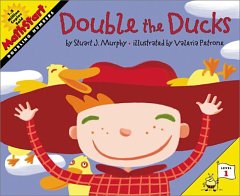 |
Double the Ducks
Author: Murphy, Stuart J. Petrone,
Valeria (Illustrator) Petrone, Valeria
ISBN:
0-06-446249-8
LCCN: 2001024321
Dewey: 513.2/13
21
Number:
|
Category:
Juvenile Mathematics
User Rating: 4.0 Stars
Pages:
40
Paperback HarperTrophy
From Booklist PreS-Gr. 1. Once again the author of the popular MathStart
series explains a math concept in a simple, exuberant story with bright, clear
pictures. A young cowboy cares for his five little ducks, and he scurries around
to bring them three sacks of food and four bundles of hay with his two hands.
When each duck brings a friend, the boy has double the ducks, so he needs to
double the hay and double the food. For that, he needs double the hands to do
the work--so, luckily, a friend joins him. The numbers are on the pages and so
are all the things to count. In a double-page spread at the back of the book,
Murphy suggests lots of activities and games for parents to use in the kitchen
and at play to make preschoolers' first steps into addition and multiplication
more fun. Hazel Rochman Copyright © American Library Association. All rights
reserved --This text refers to an out of print or unavailable edition of this
title. Product Description It's hard work, taking care of 5 little ducks. But
when each little duck comes home with a friend -- oh, no! Now it's double the
ducks and double the work. How can 1 little boy get everything done?
Understanding how to double numbers helps children master both addition and
multiplication. Fun, friendship, and lots of ducks make learning this essential
skill both easy and entertaining.
Dollar Word Riddle Book: Grades 3-8
 |
Dollar Word Riddle Book: Grades 3-8
Author: Burnes,
Marilyn Weston, Martha Weston, Martha
ISBN:
0-201-48025-5
LCCN:
Dewey:
Number:
|
Category: Humor - Jokes
& Riddles
User Rating: 4.5 Stars
Pages: 1
Paperback Addison Wesley Publishing Company
Division with Toys
|
Division with Toys
Author: Jennifer Rozines Roy and
Gregory Roy
ISBN:
LCCN:
Dewey:
Number:
|
Category:
User Rating: Pages: 0
Paperback Singapore Math/Marshall Cavendish
Divide and Ride
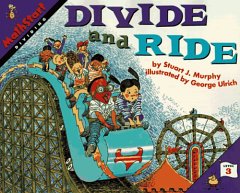 |
Divide and Ride
Author: Murphy, Stuart J. Ulrich,
George (Illustrator) Ulrich, George
ISBN:
0-06-446710-4
LCCN: 95026134
Dewey: 513.2/14
20
Number:
|
Category:
Juvenile Mathematics
User Rating: 4.0 Stars
Pages:
40
Paperback HarperTrophy
From School Library Journal Kindergarten-Grade 3. This series of introductory
math books presents various concepts on different levels. The Best Vacation Ever
shows how a family decides where to go on vacation (problem solving); Divide and
Ride shows how 11 children are able to sort themselves into smaller groups in
order to go on different rides at a carnival. In Every Buddy, a young girl
counts her friends and her pets. All books are simply written but very clear,
and concepts are explained in a number of ways. The cartoon illustrations are of
average quality and capture the many characters' diverse activities. Suggestions
are presented at the end for related activities, such as planning a picnic,
dividing snacks, and measuring to make cookies. An entertaining approach to
progressive levels of math concepts.?Christine A. Moesch, Buffalo & Erie
County Public Library, NY Copyright 1997 Reed Business Information, Inc. Product
Description Scream down the Dare-Devil Coaster and whirl around in the Twin Spin
cars! Join in the carnival fun as 11 friends divide up to fit on the 2-to-a-seat
roller coaster and the 4-to-a-cup teacups ride. Making new friends and
practicing predivision skills have never been so exciting!
Dinosaur Deals
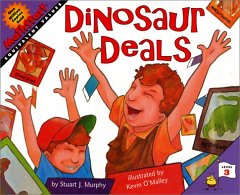 |
Dinosaur Deals
Author: Murphy, Stuart J. Henson,
Heather O'malley, Kevin (Illustrator)
ISBN:
0-06-446251-X
LCCN: 00032037
Dewey: 513
21
Number:
|
Category:
Juvenile Mathematics
User Rating: 4.0 Stars
Pages:
40
Paperback HarperTrophy
From School Library Journal Grade 2-4-Using dinosaur trading cards as a
theme, Murphy explores the concept of equivalent values. Mike and his brother,
Andy, go to a trading fair in hopes of finding a Tyrannosaurus rex card. By
making various trades they are successful in getting the coveted item. The story
contains just the right amount of tension as well as tidbits of dinosaur facts
interspersed among the math concepts. Colorful pictures of enthusiastic traders
in dinosaur masks and hats add interest. A concluding page gives suggestions of
various math activities that correlate with the book. Teachers and students
alike will find this one a winner. Anne Knickerbocker, Cedar Brook Elementary
School, Houston, TX Copyright 2002 Reed Business Information, Inc. Product
Description
Lets Make a Deal!
Mike and his little brother, Andy, are
headed for the Dinosaur Card Trading Fair. They're ready to wheel and deal.
It's, 4 Stegosaurus for 1 Triceratops, and 2 Triceratops for 1 Allosaurus. But
can they get what they really want: the tremendous, gigantic, ferocious,
Tyrannosaurus rex? The math concept of equivalency -- understanding when values
are equal -- is introduced in this fast-paced story as two brothers try to beat
the clock and make the ultimate trade.
The day the numbers disappeared [by] Leonard Simon [and] Jeanne Bendick.
Pictures by Jeanne Bendick. Pictures by Jeanne Bendick
|
The day the numbers disappeared [by] Leonard Simon [and] Jeanne
Bendick. Pictures by Jeanne Bendick. Pictures by Jeanne
Bendick
Author: Simon, Leonard Bendick, Jeanne
ISBN:
LCCN: 62021573
Dewey:
511
Number:
|
Category: Numeration -- Juvenile literature
User Rating:
Pages: 45
Whittlesey House
A teacher and his class have fun discovering the importance of numbers, their
history, the principles of various counting and numbering systems, and the basic
concept of "place value" in arithmetic.
Dave's Down-to-Earth Rock Shop
 |
Dave's Down-to-Earth Rock Shop
Author: Murphy, Stuart
J. Smith, Cat Bowman (Illustrator) Smith, Cat Bowman Smith, Cat Bowman
ISBN: 0-06-446729-5
LCCN: 98032128
Dewey:
511.3/22 21
Number:
|
Category: Juvenile Mathematics
User Rating: 4.0
Stars
Pages: 40
Paperback HarperTrophy
From School Library Journal Kindergarten-Grade 3-Each time Josh and Amy go to
Dave's Down-to-Earth Rock Shop, the window display is different. On their first
visit, the rocks are arranged according to size. The next time, they are grouped
by color. The children carefully group the specimens they have gathered
according to Mohs' scale of hardness. When they leave this collection at the
shop, Dave surprises them by displaying it in his store window. This educational
offering adequately covers the concept of classification and provides some facts
about rocks. The expressive, pleasing watercolor illustrations depict
safety-conscious children wearing bike helmets and safety goggles. While this
book will not ignite the imagination, it does support the math and science
curriculum in a palatable way. As an extension, librarians could offer Roma
Gans's Let's Go Rock Collecting (HarperCollins, 1997). Jackie Hechtkopf,
University of Maryland, College Park Copyright 2000 Reed Business Information,
Inc. --This text refers to an out of print or unavailable edition of this title.
From Booklist Murphy turns his considerable talents to the concept of
classification in this MathStart title. When Josh receives a strange rock from
his uncle, he consults an expert, shop owner Dave, to learn about his gift. He
also notices the store's display window, which features stones arranged by size.
As Josh's interest in and knowledge of geology grows, the window display
changes, with the classification scheme becoming more complex--from size to
color to type, and finally to hardness. Murphy's forte is explaining complex
topics in a down-to-earth manner, and that's just what he's done here. Along the
way, he also includes a good deal of information about rocks, minerals, and the
scientific method. Smith's full-color illustrations capture the excitement of
rock hunting and include many geological and equipment details. A good
introduction to primary geology units or lessons on classification. Activity
suggestions for adults and kids are appended. Kay Weisman Copyright © American
Library Association. All rights reserved --This text refers to an out of print
or unavailable edition of this title.
Coyotes All Around
 |
Coyotes All Around
Author: Murphy, Stuart J.
Bjorkman, Steve (Illustrator) Bjorkman, Steve
ISBN:
0-06-051531-7
LCCN: 2002151776
Dewey: 519.5/44
21
Number:
|
Category:
Juvenile Mathematics
User Rating: 5.0 Stars
Pages:
40
Paperback HarperTrophy
From School Library Journal Grade 1-3--Taking a fun approach to math, this
book introduces the concept of rounding to estimate the sum of several numbers.
A group of coyotes stands in front of a desert ranch and wonders how many
roadrunners live in the area. They split up, and each one counts the ones that
he or she sees. When they are ready to add their numbers, Clever Coyote rounds
each figure to the nearest 10, adds them together, and quickly comes up with a
close approximation of the actual total. The procedure is repeated with lizards
and grasshoppers. Humorous watercolor cartoons depict the action and clarify the
concept. Charts help to illustrate how each number is rounded. Factoids about
coyotes and other desert creatures appear throughout, so readers learn not only
math, but also get their fair share of science sprinkled into the mix. A section
entitled "Adults and Kids" includes math games, book suggestions, and ideas for
turning grocery shopping into an estimating experience.--Sandra Kitain, Abrams
Hebrew Academy, Yardley, PA Copyright © Reed Business Information, a division of
Reed Elsevier Inc. All rights reserved. --This text refers to the Hardcover
edition. Product Description Clever Coyote thinks it's time for lunch –– and
also time to show her friends how, with some simple rounding, she can add up
numbers in her head. If only she were as good at hunting as she is at math!
A Cloak For The Dreamer
 |
A Cloak For The Dreamer
Author: Friedman, Aileen
Howard, Kim (Illustrator)
ISBN: 0-590-48987-9
LCCN:
94011274
Dewey: [E] 20
Number:
|
Category:
Education
User Rating: 5.0 Stars
Pages: 40
Hardcover Scholastic Press
From Publishers Weekly While teaching a little elementary geometry, this
title in the Marilyn Burns Brainy Day series also offers a lesson about fitting
square pegs in round holes. Ivan and Alex want to be tailors like their father,
but youngest brother Misha dreams of travel. When each son must fashion a cloak
for the archduke, Ivan sews one using rectangles of fabric. Alex makes a cloak
of squares and an extra cloak of triangles. But Misha's disastrous cloak of
circles demonstrates the geometrical concept that shapes must have angles to fit
together. Seeing that Misha's heart lies elsewhere, the tailor frees his son to
travel the world. As a farewell gift, the tailor presents Misha with the fateful
cloak, whose circles he has snipped into snug-fitting hexagons and then
restitched. Friedman's story provides an agreeable front for the lesson, and
capable watercolors lend a pleasing old-world ambiance. Three pages of clearly
written instruction and teaching tips follow the story. Ages 6-9. Copyright 1995
Reed Business Information, Inc. From School Library Journal Kindergarten-Grade
3?Books written for a particular purpose are never quite as good as stories that
stand on their own, and this one is no exception. Misha, the son of a tailor,
doesn't want to follow in his father's footsteps as his brothers do, but would
rather travel the world. When the tailor tells each of his sons to make a cloak
for the archduke to test their skills, two of them make patchworks of squares,
triangles, and rectangles. Misha, inspired by the maps he pores over, cuts
circles, but they don't fit together, leaving spaces between the pieces of
fabric. Seeing the garment, the tailor realizes he must let his son follow his
dream. Misha's father and brothers fix the coat by cutting the circles into
hexagons and give it to him as a parting gift. An afterword explains about
angles, degrees, and shapes. Illustrations set the tale in a busy Eastern
European town. Tertiary colors in watercolor and pen and ink are busy and
sketchy, picturing the cluttered interior of the tailor's shop. A title for
those interested in math, or for kids who like a story to solve.?Sally Bates
Goodroe, Houston Public Library Copyright 1995 Reed Business Information, Inc.
Circus Shapes
 |
Circus Shapes
Author: Murphy, Stuart J. Miller,
Edward (Illustrator) Miller, Edward
ISBN:
0-06-446713-9
LCCN:
Dewey:
Number:
|
Category: Shapes &
patterns
User Rating: 5.0 Stars
Pages: 40
Paperback HarperTrophy
From School Library Journal PreSchool-K?A book that teaches shape recognition
cloaked in a story about a circus performance. Circles, squares, rectangles, and
triangles are introduced on every other spread. The illustrations are very
simple and linear, allowing children to identify the various shapes that appear
in the pictures. Unfortunately, although Miller uses bold, primary colors, the
illustrations lack the excitement and movement associated with a circus. The
text is dry and forced in some spots, such as "Some monkeys make a square. The
four sides are all the same." However, the straightforward narrative does make
the information accessible. More visually attractive books on the topic include
Lois Ehlert's Color Zoo (1989) and Circus (1992, both HarperCollins), and Tana
Hoban's Shapes, Shapes, Shapes (Greenwillow, 1986).?Lisa Gangemi Krapp, Sousa
Elementary School, Port Washington, NY Copyright 1998 Reed Business Information,
Inc. --This text refers to an out of print or unavailable edition of this title.
From Kirkus Reviews Murphy (Betcha!, p. 1460, etc.) adds to the MathStart series
with a book about shapes, presenting them in no less than three rings. In
lackluster rhyme, elephants show circles, horses show triangles, monkeys hold up
a square, and bears handle a rectangle. The shapes are evident in introductory
illustrations but not identified until spreads in the middle, and that's only
one inconsistency that limits the book's usefulness. Lions roar amidst plenty of
stars and diamonds--shapes that aren't mentioned in the text or found in a
previous illustration. A final spread before the show ends asks how many
circles, triangles, squares, and rectangles are in the picture, but no key is
provided to reinforce the lesson. Beyond that lesson, Miller's clean-cut
illustrations offer bright colors and bold geometric shapes, doing for the
circus what Donald Crews did for the festive procession in Parade (1983).
(Picture book. 2-4) -- Copyright ©1997, Kirkus Associates, LP. All rights
reserved. --This text refers to an out of print or unavailable edition of this
title.
Captain Invincible and the Space Shapes
 |
Captain Invincible and the Space Shapes
Author:
Murphy, Stuart J. Simard, Remy (Illustrator) Simard, Remy Simard, Remy
ISBN: 0-06-446731-7
LCCN: 00039609
Dewey:
516 21
Number:
|
Category: Juvenile Mathematics
User Rating: 5.0
Stars
Pages: 40
Paperback HarperTrophy
From School Library Journal Kindergarten-Grade 4-An excellent tool for
introducing a unit on three-dimensional shapes. After conquering galaxies,
Captain Invincible and his space-dog, Comet, prepare for an adventurous return
to Earth in their spaceship Hawk. Using the Space Shaper panel, with its
three-dimensional buttons that include a cube, a cone, and a pyramid, the
captain and the pup wage a battle against a meteor shower, poison gas, a flying
saucer, and a galactic beast. Just as the two are about to land safely, a beam
of light floods their spaceship, and an open bedroom door reveals the true
source of this journey-a child's late-night, wondrous imagination with the help
of paper, scissors, and Scotch tape. The bold cartoon art in deep, bright colors
draws readers into this fun and exciting story that is a vehicle for learning to
recognize and define geometric shapes. The concluding reinforcement strategies
and activities are very good. A good choice as a read-aloud or for independent
reading. Wanda Meyers-Hines, Ridgecrest Elementary, Huntsville, AL Copyright
2001 Reed Business Information, Inc. From Booklist Gr. 1-4. In this new entry in
Murphy's MathStart (level two) series, young astronaut Captain Invincible gives
his dog, Comet, a crash course in geometry. Piloting through space the pair
encounters several dangerous situations, which they avert by pushing one of six
three-dimensional buttons on their instrument panel, ejecting a corresponding
Spacer Shape that does the job. When an ominous gas invades the ship, for
instance, Captain Invincible pushes a conically shaped button, releasing a cone
that sucks up the gas through its circular base. The glossy Jetson-like cartoon
illustrations have high entertainment value, the shapes are clearly
identifiable, and the story gives the math lesson an out-of-this-world appeal.
Shelley Townsend-Hudson Copyright © American Library Association. All rights
reserved
Bug Dance
 |
Bug Dance
Author: Murphy, Stuart J. Santoro,
Christopher (Illustrator) Santoro, Christopher
ISBN:
0-06-446252-8
LCCN: 00044867
Dewey: 513.2/11
21
Number:
|
Category:
Animal stories
User Rating: 4.0 Stars
Pages: 40
Paperback HarperTrophy
Product Description The bugs in Coach Caterpillar's gym class are learning a
new dance. But Centipede can't do it! If he can't learn the directions left,
right, forward and backward, this class will be one big FLOP! About the Author
Stuart J. Murphy is a visual learning specialist. A graduate of the Rhode Island
School of Design, he has a strong background in design and art direction. He
also has extensive experience in the world of educational publishing. Drawing on
all these talents, Stuart J. Murphy brings a unique perspective to the MathStart
series. In MathStart books, pictures do more than tell stories; they teach math.
Stuart J. Murphy and his wife, Nancy, live in Boston.
The Boy Who Cried Wolf
|
The Boy Who Cried Wolf
Author: Yeap Ban Har
ISBN:
LCCN:
Dewey:
Number:
|
Category: User
Rating: Pages: 0
Paperback Marshall Cavendish/Singapore Math
Bigger, Better, Best!
 |
Bigger, Better, Best!
Author: Murphy, Stuart J.
Winborn, Marsha (Illustrator) Winborn, Marsha Winborn, Marsha
ISBN: 0-06-446247-1
LCCN: 00054034
Dewey:
516 21
Number:
|
Category: Juvenile Mathematics
User Rating: 3.5
Stars
Pages: 40
Paperback HarperTrophy
From School Library Journal Kindergarten-Grade 3-Jeff and Jenny are always
fighting about who has something bigger or better, while Jill just ignores them.
When the family moves to a bigger house with a separate room for each child, the
two start arguing about whose room and windows are bigger. Mom then has them
measure the windows with sheets of paper and the floor with newspaper. Ignoring
her older siblings, Jill declares her room is best since it is farthest from the
other two and near the cat's nook. This realistic story involves sibling rivalry
with a resourceful solution to a common problem. It carefully incorporates math
without being overwhelming. The colorful and humorous illustrations add to the
story, which comes to a satisfying ending with a slight twist. Follow-up
activities and a reading list are included. Nancy A. Gifford, Schenectady County
Public Library, NY Copyright 2003 Reed Business Information, Inc. --This text
refers to an out of print or unavailable edition of this title. Product
Description Bigger, Better, Best! (LEVEL 2: Area) In their family's new house,
Jenny and Jeff are driving their little sister, Jill, crazy. Who has the bigger
window? Who has the bigger bedroom? Jenny and Jeff must use a simple geometry
concept to calculate area in order to prove once and for all whose room is
bigger. Ages 6+
Betcha! Estimating
 |
Betcha! Estimating
Author: Murphy, Stuart J.
Schindler, S. D. (Illustrator)
ISBN:
0-06-446707-4
LCCN: 96015486
Dewey: 519.5/44
20
Number:
|
Category:
Juvenile Mathematics
User Rating: 5.0 Stars
Pages:
32
Paperback HarperTrophy
From School Library Journal Grade 3-4?On their way to a store sponsoring a
contest that involves guessing the number of jellybeans in a jar, two friends
encounter situations that involve numerical determinations; e.g., how many
people are on the bus, the number of cars in a traffic jam. One boy counts one
by one to obtain the answers, whereas the other one uses simple techniques to
come up with near estimations. The easy-to-read picture-book format with only
one or two sentences per page will appeal to reluctant readers, and the boys'
urban environment provides common situations to which many students will easily
relate. The uncomplicated drawings show how the boy's brain is processing data
and the skills he employs to arrive at an educated guess. The last two pages
give suggestions and ideas for adults to help children further their
understanding of the concept. A short list of similar concept books is included.
This title will be especially useful for classroom use as it provides many
possibilities for related activities.?Stephani Hutchinson, Pioneer Elementary
School, Sunnyside, WA Copyright 1998 Reed Business Information, Inc. From Kirkus
Reviews Playing with numbers--that's what this book from Murphy (The Best
Vacation Ever, 1997, etc.) is all about. Part of the MathStart series, this
entry introduces the art of estimation. Two boys are engaged in the project, one
estimating, the other counting. Their ultimate goal is to try to figure out how
many jelly beans are in a big glass jar and win tickets to a sporting event, but
the storyline bows deeply to the emphasis on estimation as a process. As the
boys head downtown to the toy store and the jelly beans, they estimate the
number of people on the bus, the numbers of cars in a traffic jam, the total
prices of goods in a window, all the while demonstrating both rounding off and
how to count a small number and apply that to the great, uncounted whole through
the use of multiplication, fractions, and simple geometry. Murphy's success is
in beveling the sharp, unforgiving reputation of math and in showing how numbers
can be toyed with. Readers may come away with the sense that they are not slaves
to numbers--it's the other way around. (further reading) (Picture book. 6-9) --
Copyright ©1997, Kirkus Associates, LP. All rights reserved. --This text refers
to an out of print or unavailable edition of this title.
The Best Vacation Ever
 |
The Best Vacation Ever
Author: Murphy, Stuart J.
Westcott, Nadine Bernard (Illustrator)
ISBN:
0-06-446706-6
LCCN:
Dewey:
Number:
|
Category: Juvenile
Mathematics
User Rating: 2.0 Stars
Pages: 40
Paperback HarperTrophy
From School Library Journal Kindergarten-Grade 3. This series of introductory
math books presents various concepts on different levels. The Best Vacation Ever
shows how a family decides where to go on vacation (problem solving); Divide and
Ride shows how 11 children are able to sort themselves into smaller groups in
order to go on different rides at a carnival. In Every Buddy, a young girl
counts her friends and her pets. All books are simply written but very clear,
and concepts are explained in a number of ways. The cartoon illustrations are of
average quality and capture the many characters' diverse activities. Suggestions
are presented at the end for related activities, such as planning a picnic,
dividing snacks, and measuring to make cookies. An entertaining approach to
progressive levels of math concepts.?Christine A. Moesch, Buffalo & Erie
County Public Library, NY Copyright 1997 Reed Business Information, Inc. From
Kirkus Reviews This entry in the MathStart series demonstrates that collecting
data and tabulating results can help the decision- making process. A girl with
an active, overscheduled family puts math to work to coordinate a family
expedition. She uses charts to plot her family's preferences: Should they go far
away or remain nearby? Go someplace warm or cold? Have fun or relax? Bring the
cat or leave it at home? By tabulating the results the family discovers the
majority favors a warm, local, cat-friendly, fun destination (that the family is
a democracy is assumed, but then, the goal is math, not civics)--in other words,
the backyard. Amiable watercolor illustrations accompany the clumsy rhymes:
``What about excitement?/We'd like some quiet and some rest./We have such a good
time here/that a fun place would be best.'' Two pages of instructions are
included for imagination-impaired adults (``Ask the child to answer the girl's
questions: `How about you? Would you rather take a vacation somewhere warm or
cool?' ''). Serviceable fare. (Picture book. 6-11) -- Copyright ©1996, Kirkus
Associates, LP. All rights reserved. --This text refers to an out of print or
unavailable edition of this title.
The Best Bug Parade
 |
The Best Bug Parade
Author: Murphy, Stuart J. Keller,
Holly (Illustrator)
ISBN: 0-06-446700-7
LCCN:
Dewey:
Number:
|
Category: Juvenile Mathematics
User Rating: 3.5
Stars
Pages: 40
Paperback HarperTrophy
From School Library Journal PreSchool-Grade 1?A parade of bugs introduces
size relationships in this playful approach to beginning math concepts.
Comparisons of big (bigger, biggest) small (smaller, smallest), and long and
short are presented by an assortment of cheery insects marching through a
colorful environment of flowers and grass. Some of the insects, such as a
ladybug, are easily identifiable, while others are more fanciful. A spacious
format with large print and brief text gives Keller's expressive creatures lots
of space to enliven the concepts. A double-page section of suggested activities
for adults to share with children is included. Early childhood teachers and
parents will all find this a useful book, and youngsters will be attracted to
the lively illustrations. A good choice to pair with Bruce McMillan's Super,
Super, Superwords (Lothrop, 1989).?Diane Nunn, Richard E. Byrd Elementary
School, Glen Rock, NJ Copyright 1996 Reed Business Information, Inc. Product
Description The bugs are on parade. One is big, the next is bigger, and the next
is the biggest bug of all. Learning how to compare and contrast sizes is an
important early math skill and one of the most basic forms of mathematical
reasoning. In The Best Bug Parade children are introduced to this concept by
some goofy-looking bugs who form a parade. Author Stuart J. Murphy and
illustrator Holly Keller have made comparing sizes an enjoyable activity for the
very youngest math student. 1996 ?Pick of the Lists' (ABA)
Beep Beep, Vroom Vroom!
 |
Beep Beep, Vroom Vroom!
Author: Murphy, Stuart J.
Demarest, Chris L. (Illustrator)
ISBN:
0-06-446728-7
LCCN: 98051907
Dewey: 515/.24
21
Number:
|
Category:
Juvenile Mathematics
User Rating: 4.0 Stars
Pages:
40
Paperback HarperTrophy
From School Library Journal PreSchool-Grade 1-This fine offering introduces
the concept of patterns. Kevin has red, yellow, and blue cars that he always
lines up in a special way on his shelf. His little sister Molly wants to play,
but is told she is too young. Of course, she takes a turn the second Kevin
leaves the room. Overhearing the "vrooming, crashing, and beeping," Dad and Mom
remind her that she must put the cars back on the shelf exactly the way Kevin
left them. This allows her several opportunities to arrange the vehicles in
different ways. This clever book not only gives young readers the opportunity to
identify color patterns, but also has the added bonus of a repetitive story,
complete with sound effects. Whenever the children play with the cars, some
variation of the refrain "VROOM VROOM zoomed the red cars. BEEP BEEP honked the
yellow cars. CRASH CRASH banged the blue cars" ensues. Primary-color cartoon
illustrations depict the family, a playful pooch, and plenty of toy-car action.
Two concluding pages provide discussion questions and activities to reinforce
the math as well as a few suggestions for further reading. However, many
children will enjoy this book simply for the story and the colorful pictures.
Jackie Hechtkopf, Rose Ruth Freudberg Memorial Library, Washington, DC Copyright
2000 Reed Business Information, Inc. From Booklist Like all Murphy's MathStart
titles, this lively picture book uses a story from a child's daily world to
teach a basic math skill. Here the math is pattern recognition, and the story
combines sibling rivalry with hands-on play. Molly loves playing with cars, but
her brother, Kevin, tells her she's too young. He lines up his 12 cars--four
red, four green, four yellow--in special order on the shelf and tells her not to
touch them while he's gone. Of course, she does play with them (Vroom! Beep!
Crash!), and every time someone comes in, she lines up the vehicles in different
sequences, until, finally, she gets her own sets of cars to add to the game. At
the back are practical suggestions for adults and kids to find patterns on the
pages and make their own patterns with pebbles, buttons, coins, and kitchen
utensils. Demarest's clear, simple pastel pictures express the fun of playing
with cars as the vrooming action reveals the patterns in everyday things. Hazel
Rochman Copyright © American Library Association. All rights reserved --This
text refers to an out of print or unavailable edition of this title.
Baa, Baa, Black Sheep
|
Baa, Baa, Black Sheep
Author: Yeap Ban Har
ISBN:
LCCN:
Dewey:
Number:
|
Category: User
Rating: Pages: 0
Paperback Marshall Cavendish/Singapore Math
Animals on Board
 |
Animals on Board
Author: Murphy, Stuart J. Alley, R.
W. (Illustrator) Alley, R. W. Alley, R. W.
ISBN:
0-06-446716-3
LCCN:
Dewey:
Number:
|
Category: Numbers &
counting
User Rating: 4.0 Stars
Pages: 40
Paperback HarperTrophy
From School Library Journal PreSchool-Grade 2-This picture book tells a story
and reinforces the concept of addition. The lively watercolor illustrations
serve both missions well. While on the road, a female truck driver and a dog are
passed by many other vehicles loaded with various animals. As their journey
advances so do the math problems, going from the simple "3 + 2 = 5" to the final
"9 + 0 = 9." However, there is no logical progression in the examples provided;
why does "6 + 1 = 7" follow "3 + 2 = 5?" The text is told in rhyme, which adds
to the sense of movement but it is rather singsong. All of the characters end up
at a carousel (made from the drivers' freight) and the final illustrations
capture their joy and excitement. The book ends with a two-page spread of
suggested activities for kids and adults. The "Level 2" designation suggests
that this is designed for ages 6 and up but the simplicity of the story and
rhyme as well as the juvenile nature of the illustrations would be more
appealing to a younger audience. Edith Ching, St. Albans School, Mt. St. Alban,
Washington, DC Copyright 1999 Reed Business Information, Inc. From Booklist From
the MathStart series, this story in rhyme lays out five simple addition
problems. A truck driver, Jill, watches as a series of trucks--all pulling
different animals--pass her by. The math gets worked into the story as Jill
adds, for example, the six swans on one truck to the one swan on a second truck
(6+1=7 is imbedded in the text). Using this pattern, the reader is able to
practice addition while guessing the trucks' final destination. The last line of
the story reads "Can you find 5 tigers, 7 swans, 8 frogs, 10 horses, and 9
pandas?" , and Alley's watercolor shows a giant carousel. Two pages of
activities are appended, but an obvious omission is asking children to calculate
the total number of animals on the carousel. Kathy Broderick --This text refers
to an out of print or unavailable edition of this title.
Amanda Bean's Amazing Dream
 |
Amanda Bean's Amazing Dream
Author: Neuschwander,
Cindy Burns, Marilyn Litzinger, Rosanne
ISBN:
0-590-30012-1
LCCN: 97007056
Dewey: [E]
21
Number:
|
Category:
Juvenile Fiction
User Rating: 4.5 Stars
Pages: 40
Hardcover Scholastic Press
From School Library Journal Kindergarten-Grade 3-The advantages of
multiplication are introduced in a simple story about an African-American girl
who loves to count things, both in and out of school, but is unsure how
multiplication will speed up the process. After counting the tiles on the
kitchen counter and the books on the library shelves, she falls asleep and
begins to dream of a calm bike ride in the country. Then, eight sheep on
bicycles come zooming by and stop at a barn to get five yarn balls apiece to
give to seven grandmothers knitting sweaters. Amanda is overwhelmed by trying to
tot up bicycle wheels, sheep legs, knitting needles, and sweater arms-until the
sheep and the grandmothers begin shouting, "Multiply!" She awakes, convinced
that she wants to learn how. Large, lively, ink-and-watercolor cartoons in
cheerful colors are filled with objects to count, from lollipops to windowpanes.
A comprehenive guide for adults on the usage of the principles and pictures in
the book is included. Patricia Pearl Dole, formerly at First Presbyterian
School, Martinsville, VA Copyright 1998 Reed Business Information, Inc. From
Booklist Ages 6^-8. Known to her friends as Bean Counter, young Amanda Bean
happily counts "anything and everything" by ones, twos, fives, and tens.
Although her teacher tells her that learning multiplication is important, Amanda
remains unconvinced until a strange dream presents her with arithmetic
challenges that overwhelm her counting skills. She awakens (in both senses) and
learns to multiply "anything and everything." The purpose of the tale could have
sunk this picture book with its pedagogical weight, but the light tone of the
first-person text and the deft drawing, bright hues, and buoyant good humor of
Woodruff's ink-and-watercolor illustrations keep it afloat. The book ends with
suggestions for using the book to teach multiplication. Carolyn Phelan
Addition in the Forest
|
Addition in the Forest
Author: Jennifer Rozines Roy
and Gregory Roy
ISBN:
LCCN:
Dewey:
Number:
|
Category:
User Rating: Pages: 0
Paperback Singapore Math/Marshall Cavendish
Addition in the Forest
|
Addition in the Forest
Author: Jennifer Rozines Roy
and Gregory Roy
ISBN:
LCCN:
Dewey:
Number:
|
Category:
User Rating: Pages: 0
Paperback Singapore Math/Marshall Cavendish
The 329th Friend
 |
The 329th Friend
Author: Sharmat, Marjorie Weinman
Szekeres, Cyndy (Illustrator)
ISBN:
0-02-782259-1
LCCN:
Dewey:
Number:
|
Category:
General
User Rating: 5.0 Stars
Pages: 48
School & Library Binding Marcel Dekker
Card catalog description Bored with his own company, Emery Raccoon invites
328 guests to lunch but finds that none of them have time to listen to him.
--This text refers to an out of print or unavailable edition of this title.
3 Little Firefighters
 |
3 Little Firefighters
Author: Murphy, Stuart J. Lum,
Bernice (Illustrator) Lum, Bernice
ISBN:
0-06-000120-8
LCCN: 2002019062
Dewey: 511.3/22
21
Number:
|
Category:
Juvenile Mathematics
User Rating: 4.0 Stars
Pages:
40
Paperback HarperTrophy
Product Description We're missing all our buttons! Three firefighters
scramble to find 3 sets of matching buttons before the big parade starts. A
lively introduction to the simple math concept of sorting by attributes. Card
catalog description Three young firefighters must find matching sets of buttons
to complete their costumes for a parade, but should they sort them by shape,
color, or size? --This text refers to the Hardcover edition.
The 13 Nights of Halloween
 |
The 13 Nights of Halloween
Author: Dickinson, Rebecca
ISBN: 0-590-47586-X
LCCN: 95030065
Dewey:
[E] 20
Number:
|
Category: Holidays & Celebrations - Halloween
User
Rating: 5.0 Stars
Pages: 32
Paperback Scholastic
Card catalog description Following the pattern of the folk song, Twelve days
of Christmas, a goblin guy gives his goblin gal a different present each of the
thirteen nights of Halloween.
100 Days of Cool
 |
100 Days of Cool
Author: Murphy, Stuart J.
Bendall-Brunello, John (Illustrator) Bendall-Brunello, John
ISBN: 0-06-000123-2
LCCN: 2002019061
Dewey:
513.2/11 21
Number:
|
Category: Juvenile Mathematics
User Rating: 5.0
Stars
Pages: 40
Paperback HarperTrophy
From School Library Journal Kindergarten-Grade 2--Four friends arrive at
school on opening day wearing the jazziest of outfits, having heard that their
new teacher intends to celebrate "100 days of cool." Although Mrs. Lopez really
meant to mark "100 days of school," she challenges the students to continue for
an additional 99 days, and the foursome collaborates to generate ideas for lots
of silly costumes, playful pranks, and a more serious yet equally "cool"
community service project. Despite their classmate Toby's doubts, the friends
come up with a daily surprise and a means of marking the way to 100 and the
promised party. This simple story focuses on the single concept of counting to
100. A number line divided by tens appears at the top of most pages, and the
cheerful illustrations reflect students of all backgrounds and physical
abilities. Arbitrary numbers such as 8, 17, and 41 are given equal fanfare with
typical number intervals like 5, 10, and 25. While the book offers reliable
reinforcement for one-by-one counters, it won't dazzle children who are ready to
investigate numbers in groups. Trudy Harris's 100 Days of School (Millbrook,
1999) and Elinor Pinczes's perpetually cool One Hundred Hungry Ants (Houghton,
1993) are more imaginative choices. An additional purchase.--Gloria Koster, West
School, New Canaan, CT Copyright © Reed Business Information, a division of Reed
Elsevier Inc. All rights reserved. --This text refers to the Hardcover edition.
From Booklist K-Gr. 3. Murphy once again uses a lively classroom scenario to
dramatize important math concepts. Here a group of kids come to school dressed
"cool" in sequins and sunglasses for "the first day of cool," and their cool
teacher challenges them to keep it up for 99 more days. The next day the kids
wear cool socks. On Day 5 they decorate their bikes. On Day 25 they dye their
hair. A number line from 1 to 100 across the top of each double-page spread
shows the passing time, and one carping kid always comments on how far the class
still has to go ("They're only 1/10th of the way there"). The colored-pencil
pictures show the kids in all their costumes and at play and work. The play and
socializing dramatize the math, and, as always in the books in the fine
MathStart series, there are suggestions to help adults talk about the concepts
and relate them to a child's daily life. Hazel Rochman Copyright © American
Library Association. All rights reserved --This text refers to the Hardcover
edition.